The College of the Ozarks in Point Lookout, Missouri is continuing its fight against a Biden policy forcing women to share dorms, bathrooms, and other public spaces with biological males.
The Christian college filed a lawsuit against a memorandum ordering the U.S. Department of Housing and Urban Development to enforce the Fair Housing Act, which does not allow entities to discriminate based on sexual orientation and gender identity. The school filed a complaint in April against the February 11 memorandum, but a judge dismissed its lawsuit.
Now, the U.S. Court of Appeals for the Eighth Circuit has agreed to expedite arguments in the lawsuit for a hearing set for November, the Christian Post reported. The Christian college maintained that the Biden policy violates their First Amendment rights, arguing that the memorandum “was issued without observance of procedure required by law, and is contrary to law, arbitrary, capricious, in excess of statutory jurisdiction, and contrary to constitutional rights.”
The College of the Ozarks added that the memorandum “requires private religious colleges to place biological males into female dormitories and to assign them as females’ roommates.” They said that the directive prohibits “all regulated entities, including the College” from “discriminating on the basis of sexual orientation or gender identity both in occupancy of their dwellings and in policies governing those dwellings.”
The directive also prevents the school from mandating its students to be placed in dorms “based on their biological sex.”
College officials said that for years, students have been separated in dorms, bathrooms, and other “intimate spaces” based on their biological sex. They also claimed that the HUD “failed to take into consideration the College or other entities with similar student housing policies in promulgating the Directive.”
The Christian college’s case was dismissed in June, when U.S. District Judge Roseann A. Ketchmark, who was appointed by former President Barack Obama, said that the Ozarks failed to demonstrate how the memorandum caused “a concrete and particularized harm that is actual or imminent, not conjectural or hypothetical.”
The Christian college argued that the new memorandum would violate its First Amendment rights, as it “would suffer immeasurable harm to its religious exercise, its free speech, and its students’ privacy interests.” They believe that abandoning its code of conduct “jeopardizes the College’s ability to function, harms students, and dissuades them from attending the College,” Inside Higher Ed reported.
Alliance Defending Freedom’s senior counsel Julie Marie Blake, who represents the College of the Ozarks, explained that the school, also known as “Hard Work U,” does not charge tuition and welcomes students “who agree to follow its code of conduct” and is targeted at those who have “the most financial need.”
She added that threatening the school with “ruinous fines that could be in the six figures” will endanger its much needed public service.
The Christian college lamented that the new directive will most likely cause “investigations, enforcement actions, and litigation that could impose costly discovery and legal fees, millions in penalties and punitive damages, and criminal penalties against the College and its employees.”
Stung by its rout in Afghanistan, the US is doubling down on efforts to punish homegrown dissidents. But while the post-January 6 crackdown brought it into the public eye, the domestic ‘war on terror’ has been underway for years.
As the 20th anniversary of the 9/11 terror attacks looms this weekend, the Department of Homeland Security wants to make sure you’re afraid – very afraid. Americans, it warned last month, are facing an enemy so drunk on mind-warping conspiracy theories that even the most sophisticated surveillance apparatus in the world can’t stop them.
Subtlety has never been the strong point of the country’s ever-multiplying intelligence agencies and, for the 9/11 anniversary, the government is pulling out the stops for an orgy of fear not seen since the event itself. The recent DHS bulletin warned the surrounding weeks would be marked by a “heightened threat environment” – at least until Veterans Day, when a new excuse will likely be rolled out to be very afraid. It even dredged up al-Qaeda themselves, declaring the terror group had released its first English-language magazine in four whole years, apparently believing American dissidents would be inspired by their country turning tail and fleeing from Kabul.
But the DHS and its ilk have been screaming about terrorism since January 7, the day after hundreds of pissed-off Trump voters and other disaffected Americans stormed the Capitol in what has been retroactively recast as an armed insurrection – in the absence of any arms or of attempts on the life of any legislator. As with September 11 itself, law enforcement agencies are publicly atoning for their supposed catastrophic intelligence failure by cracking down on the dissidents they do know about – the equivalent of closing the barn doors as the last horse gallops across state lines – and papering over the logical gaps with rhetorical bluster. Except, in this case, the “If you see something, say something” of 20 years ago has become the more direct “snitch on your family”.
If the definition of insanity is indeed doing the same thing over and over while expecting different results, the American intelligence apparatus can be said to be well and truly batty. Bringing back home the same “war on terror” tactics that lost the war in Afghanistan, nearly fumbled it in Iraq, and have all but lost it in Syria is asking for yet another massive failure, one that will be much more difficult to recast as victory as its targets need not rely upon untrustworthy news media for information on what is happening outside their doors.
Ordering police forces – already a symbol of incipient US fascism to many after the backlash against police brutality that exploded last summer in the form of Black Lives Matter (and other actual riots) – to deploy these tactics against their fellow Americans almost guarantees a rebellion. And Americans, unlike the goat-herders in dirt-poor Afghanistan, have been stocking up on guns and ammo so much that manufacturers are staring down two-year delays in restocking.
But, while Covid-19 and the 2020 election may have unmasked the extent of the project, the designation of dissident Americans as the enemy has been underway for longer than many believe. Just as the neocons at the Project for a New American Century didn’t wait for the planes to hit the towers to write up their contingency plan for the ‘new Pearl Harbor’ existential crisis that 9/11 became, that group’s spiritual descendants have been cooking up some frightfully draconian legislation while the country was distracted with four years of Trump Derangement Syndrome. Those behind War on Terror 2.0 already have the dystopian tools at hand to wage unprecedented domestic warfare – all they need now is the proper catalyst.
This is why, nine months after the fact, we’re still hearing about the January 6 riot at the Capitol. Never mind that the only victims of that sad-sack demonstration were among the pro-Trump crowd – and that one of the supposed leaders of this big scary insurrection, Proud Boys chief Enrique Tarrio, was a known FBI collaborator. We’re told to fear “white ISIS” anyway, these LARPing boys in black having dropped seamlessly into the terror narrative where al-Qaeda and its boxcutters of doom once stood. It was “the most violent attack since the British burned the Capitol in 1814,”former Bloomberg News editor Albert Hunt wrote in an op-ed for the Hill, joining the tireless chorus that has spent so many months to try to puff up the rally into something it wasn’t.
Indeed, these ‘white supremacists’ – some of whom, to the embarrassment of the FBI and DHS, aren’t actually white – are said to be so dangerous that they must be brainwashed out of their political views if there is any hope of reintegrating them into society.
One need only look at the case of Doug Jensen, one of hundreds locked up in the aftermath of the Capitol protest. Finally released on bail after six months, having promised he’d gotten his mind right and no longer believed in QAnon and others who questioned the 2020 election results, he was caught in his garage earlier this month watching a video of Mike Lindell, a.k.a. “MyPillow Guy,” one of the leading lights (dim as they may be) in the delusional community who believed Trump would be reinstated as president last month. Sending him back to jail for such a minor transgression harks back to the McCarthy era – “are you now or have you ever been a follower of MyPillow Guy?” – and spits in the face of any notion that the country is still, as it stridently claims, ‘Our Democracy.’
The increasingly open trend towards thought reform (brainwashing) as a prerequisite for an innocent verdict (or even bail) should terrify those on the Left as much as it does the Right. But they continue to fiddle while Rome burns, “othering” their ideological foes with dime-a-dozen smears like “white supremacist.” This puts them in bed with their avowed enemies the New York Police Department, which – after being handed unprecedented powers to spy on its own citizens following 9/11 – got on the “white supremacist” hunt early, starting a unit to deal with these types (who are vanishingly uncommon in a proudly multi-cultural city like New York) back in 2019.
Equipped with dystopian technology like super-powered X-ray vans that can see human activity inside a car (or ground-floor home) and the Domain Awareness System, which constitutes the largest network of cameras, license-plate scanners and other sensors in the world, the department has primarily been using the weapons of war to bust petty criminals. One need only look at the spike in crime the city has seen over the past two years to be reminded that this tactic simply does not work – but then, that assumes the purpose is to bring down crime statistics.
The New York Times notes that “it is almost impossible to overstate how profoundly the [9/11] attacks changed American policing,” particularly in New York, which seems to be sliding into full-blown fascism thanks to the government’s response to the Covid-19 pandemic. Told they could no longer so much as ride a subway train bare-faced without a $50 fine, most New Yorkers have simply assumed there are cameras everywhere and dutifully masked up, even when many independently express concerns the whole masking ritual is at best a cultish rite – and at worst an effort to dehumanize one’s fellow man. After all, there are criminals about – a lot of them! – and the boys in blue are keeping us safe when they place their boots on our necks and apply just the right amount of loving pressure.
The lofty battle cry the Bush administration let loose upon sending American soldiers into the 20-year quagmire that Afghanistan would become was that we must ‘get the terrorists,’ lest they rob us of our freedoms. But instead of safeguarding them, American leaders memory-holed those freedoms as quickly as possible – the better to make “our boys” returning from Afghanistan feel right at home. The war is here, and the real terrorists – those in Washington – are already doing their victory dance. Let us hope it’s premature.
Army Sgt. Maj. Michael Carter clearly remembers the horrific scenes of the flame-filled Twin Towers imploding against the New York City skyline.
A doctor’s appointment that morning made him late for school and as he walked the hall toward his classroom, every teacher at Rancho Vista High School in Temecula had a TV on showing images of the airplanes hitting the buildings of the World Trade Center.
“I felt enraged, disconnected and I wanted to do something,” Carter said. “I saw the country in turmoil and I wanted to serve.”
Just hours later, during a birthday party for a younger cousin, he informed family members that he would enlist. His grandfather had served in the Marine Corps and he felt it was his duty as the eldest in his family to follow in those footsteps.
“I knew that was my way of fighting terrorism,” he said.
Then a high school junior, he enlisted in the Army’s delayed entry program and shipped off to basic training on July 22, 2003. He first served in the 82nd Airbourne out of Ft. Bragg, N.C., and now is an Army operations sergeant major for the Southern California Army Recruiting Battalion.
Carter is among the thousands of Americans who, in a surge of patriotism, showed up at their hometown recruiting offices following the 9/11 terrorist attacks looking to stand up for their country and become part of something bigger than themselves.
Many who signed up between 9/11 and 2011 served tours in both Iraq and Afghanistan.
On Aug. 31, the last U.S. troops withdrew from the airport in Kabul, Afghanistan, marking an end to America’s longest war, one that started as the United States pursued Al Qaeda in response to the Sept. 11 attacks.
Driven from power after the U.S. and its allies invaded Afghanistan shortly after the 2001 terrorist strike, Taliban forces took over the county in just 10 days last month as American troops withdrew.
The chaos of the withdrawal, including the bombing at the Kabul airport in which 13 American service members and at least 169 Afghans died, drew criticism for President Joe Biden and his administration.
And it led some to wonder what the impacts of those globally viewed images will mean for the future of the military and its ability to retain and recruit service members.
“Everybody who joined then not only felt an obligation but had a certain passion,” Carter said. “We owned that war.”
At first, the swell of patriotism and people flocking to enlist didn’t translate to a larger military force. Military recruitment is dictated by the requests of commanders and the budgets voted on by Congress; each branch is given an “end-strength number.”
But soon, in the years after 9/11, the branches’ numbers did swell as America’s war on terrorism took shape and requests for larger numbers of enlisted to fill new missions were made.
In FY 2000, the Army, as an example, needed 482,179 people. As the conflicts in Iraq and Afghanistan ramped up, the required number of troops steadily climbed from 543,000 soldiers in 2008 to 565,000 in 2011.
The Marine Corps, too, saw its end-strength numbers increase from about 173,321 in 2000 to 186,442 in 2006. Then to 202,441 in 2010, when efforts in Afghanistan really built. The Air Force also saw an influx of volunteers, with a high of 349,369 enlisted and officers taking the oath in 2005. In the Navy, in 2002, 46,155 new sailors joined.
“What we saw after 9/11 was a surge in militaristic patriotism, a way for citizens to use the armed forces as a display of strength after such a horrific attack on our home soil,” said Gregory Daddis, a former Chapman University professor who now is the USS Midway Chair in Modern U.S. Military History at San Diego State University. Daddis, who earned a Bronze Star, served in the Army for 27 years, including in Operations Desert Storm and Iraqi Freedom.
“The focus on exacting revenge via a military campaign against terror allowed ordinary Americans,” he said, “the chance to participate in redeeming the nation’s honor and thus burnish their own patriotism.”
Americans seemed to collectively use war to “provide meaning to an attack that seemed so senseless to so many,” he said.
Beth Asch, a senior economist who studies military recruitment, enlistment and compensation for the Rand Corporation, said another factor played into recruitment success: Facing higher end-strength numbers, military recruiters capitalized on the swell of interest by bolstered their efforts with bonuses for those who joined, offered better pay and provided special options for those who took on specific military jobs.
Congress also implemented pay raises, making military service more attractive.
“You look at the survey data and you definitely see an increase,” she said. “The services did well after 9/11.”
While fought by a much smaller military than World War II or even the following conflicts, the wars in Afghanistan and Iraq were the first real test of an all-volunteer force.
Marine Master Gunnery Sgt. Ray Gallimore, who joined in 1991, watched the shift over the next decade. He saw the military drawdown its numbers with the thawing of the Cold War, only to ramp up again a bit before 9/11.
“I wanted to serve my country and was compelled to do my part,” said Gallimore, who a decade in, with the 3rd Battalion/6th Marines, helped secure the Kandahar Airfield in Afghanistan and the embassy in Baghdad shortly after 9/11.
Gallimore said he witnessed a shift in overall patriotism, not only among those who volunteered, but he saw the tangible effects across the nation, too.
“It was surreal,” he said, adding he heard stories from friends whose relatives served during Vietnam and felt they had not been supported by the people back home. He wondered how he would be treated.
“Everyone was treating us as heroes,” he said. “Everywhere you went, someone was wanting to shake your hand and thank you for serving. I wasn’t used to that.”
It didn’t end there. As he moved to a recruiting post with the Marines, the outflow of pride in the military and the country continued.
“We saw an influx of phone calls of people who wanted to do anything they could to serve, even from a lot of older retired Marines,” he said. “It was crazy, they were serious; 9/11 was our Pearl Harbor. Everyone rallied around the flag. There was a spike of young men and women who came to be a part of something bigger.”
The enthusiasm for service also extended in more cases to parents, he said.
“It was much easier to talk to parents because their children were so passionate,” he said. “It was their generation and their time to fight for democracy. Parents were more open to it.”
But as the war drew on, interest among the civilian population waned. And, the reasons people had for service changed.
“People lost sight of why we were there in the prolonged war,” Gallimore said.
He has served as a career recruiter for the Marines and is presently at the Marine Corps Recruit Depot San Diego. “Seeing all the casualties, views and opinions changed. It wasn’t that people were less patriotic, but they were less willing to serve.
“It made parents and kids question, ‘Why should I join?’ People lost sight of the reason we were still there.”
And now, watching the withdrawal, he said, “It pains me to see what’s going on now.”
“When we were on the ground, we obliterated the Taliban,” he said.
Still, some military branches now report they are meeting — or even exceeding — current recruitment goals and are attracting better-qualified recruits.
Of the 1% nationwide who joined to fight the war on terrorism — especially in comparison to past wars such as Vietnam where the Army’s ranks were more than 1.3 million and the Marines had nearly 260,000 — many who stepped forward, joined because military service had become a family tradition.
By 2009, when the end-strength numbers for military branches increased again because of the renewed focus on Afghanistan, economic reasons, rather than simply being patriotic, had become part of the decision process.
The post- 9/11 version of the GI Bill pays for full tuition and fees for all public universities and colleges and includes a monthly housing allowance.
College tuition and solid training for a future career factored into the equation for many considering enlistment. And, military service ensures a paycheck and benefits.
Carter’s twin sisters — Army Pvt. 2nd Class Madison David and Army Pvt. 2nd Class Jenna Davis — followed their brother and grandfather into service. But they also looked to the Army for new possibilities.
Carter helped enlist them in April 2017 through the Army’s delayed entry program. They went to basic training at Fort Jackson in 2018 after graduating from Temecula Valley High School. Both just returned from deployments; one sister was in Germany and the other in North Africa.
“They saw how well the military takes care of their families,” Carter said. “It was something they wanted and they also wanted to carry on the tradition.”
“The Army is a stepping stone,” he said. “In four years, you’ll be 10 years ahead of those who went to college. Sixty percent of those who go to college graduate with debt and never work in that field again.”
Army recruiters now focus on offering career paths for future soldiers. In the last few years, they have stepped up their recruiting along the West Coast and in more urban markets.
The Rand Corporation’s Asch said she isn’t sure how the recent withdrawal from Afghanistan, and the bloody mark left by the airport bombing in its last days, will affect the future of military recruitment.
Seeing their peers among those killed might give younger people pause when considering enlistment.
But the Afghanistan war had largely fallen out of the public eye, until recently, Daddis pointed out.
“I’m not convinced the tumultuous withdrawal will have much impact on recruiting efforts,” he said. “Nor do I think the American public will cast much blame on the soldiers and Marines who fought there. My sense is most Americans feel like they were placed in a difficult, if not impossible, situation and, for the most part, performed admirably and honorably.”
Roger Stone, former President Donald Trump‘s longtime confidant, said he believes his friend has decided to run for the White House again in 2024.
“Based on my communications with him, I now believe that he will be a candidate,” Mr. Stone said about Mr. Trump in a video uploaded Thursday. “I believe that he‘s crossed that Rubicon in his mind.”
Mr. Stone, a friend of Mr. Trump’s of more than 30 years, made the remark during an interview conducted by another close acquaintance of his, conspiracy theorist Alex Jones, the publisher of the Infowars website.
Appearing on camera from the passenger seat of an occasionally moving car, Mr. Stone said in the video that he only recently determined that Mr. Trump is best suited to be the Republican Party’s nominee again.
“He‘s our best candidate. I’ve come to that conclusion. If you’d asked me that three weeks ago, I would have put a bunch of caveats on it, but not anymore. There is no one else,” Mr. Stone said about Mr. Trump.
“He is the leader. He remade the Republican Party in his image, and that’s not going to change anytime soon,” he said. “We’re never going back to being the country club party of the Bushes. You can forget that.”
Mr. Trump has repeatedly hinted at running for the White House since his presidency ended in January, and a number of his allies have suggested a 2024 campaign is in his cards.
If elected in 2024, Mr. Trump, the only president in U.S history to be twice impeached, would become the second to serve two non-consecutive terms. Grover Cleveland was both the 22nd and 24th president.
Mr. Stone, 69, briefly served on the Trump presidential campaign. He was later found guilty of multiple felony charges brought as a result of the government’s investigation into Russian interference in the 2020 election and was ordered to serve 40 months in prison. Mr. Trump granted him a presidential pardon and commuted his sentence, however. Several other Trump allies were similarly convicted but later cleared.
Shortly before saying he believes Mr. Trump will run in 2024, Mr. Stone all but admitted the former president told him as much.
“Roger, let’s get down to brass tacks. Trump told you he‘s going to run,” Mr. Jones said.
“I would never say that on the air,” Mr. Stone responded with a smirk as Mr. Jones started laughing. “But if you said it, I wouldn’t contradict you.”
(Scientific American) Those who were exposed to Ground Zero have increased rates of certain cancers and other health problems.
John Feal, now 54 years old, was a supervisor at a demolition company when terrorists hijacked two planes that brought down the World Trade Center buildings—and two others that crashed into the Pentagon and a field near Shanksville, Pa., respectively—20 years ago. Feal, who hails from Long Island, N.Y., arrived the day after New York City’s iconic buildings came down. He had been working at Ground Zero for five straight days when 8,000 pounds of steel crushed his left foot.
Feal spent 11 weeks in the hospital, eventually developing gangrene, losing half of his foot and relearning how to walk. He has since undergone 42 surgeries and developed arthritis in about 80 percent of his body, and he suffers chronic problems with his hips, knees and lower back. Feal created a foundation that has been instrumental in fighting to ensure 9/11 responders and survivors receive the health care they deserve for the sacrifices they made.
“Most Americans just think two buildings came down that day and innocent lives were lost to senseless violence, and that did happen,” Feal says. “But many don’t know that tens of thousands of people got sick, and many have died since then from their illnesses contracted at Ground Zero.”
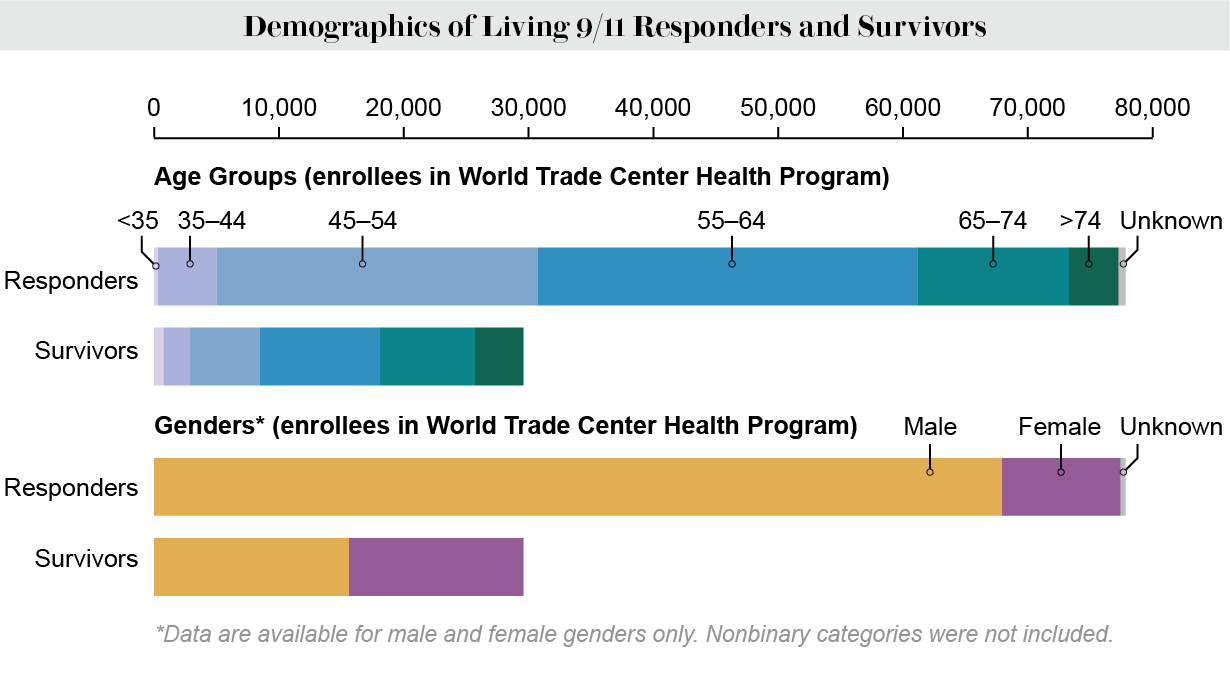
Nearly 3,000 people died during the deadliest terrorist attack in world history. But in the two decades since then, the number of deaths among survivors and responders—who spent months inhaling the noxious dust, chemicals, fumes and fibers from the debris—has continued creeping up. Researchers have identified more than 60 typesof cancer and about two dozen other conditions that are linked to Ground Zero exposures. As of today, at least 4,627 responders and survivors enrolled in the World Trade Center (WTC) Health Program have died.
Not all those deaths can be attributed to conditions linked to Ground Zero exposures: the WTC Health Program tallies members who have died for any reason, including accidents and conditions unrelated to 9/11, in the 20 years since the attacks. But the program—established to provide health care for 9/11-related ailments in responders and survivors—has had only a bit more than 112,000 members, a fraction of the estimated 410,000 first responders, cleanup crew workers and survivors exposed to all that contaminated air. There are undoubtedly others who have died from 9/11-related conditions who were not enrolled in the program.
“With the 20th anniversary of 9/11 approaching, it is impossible not to reflect on how the World Trade Center attacks continue to exert a painful human toll,” says Moshe Shapiro, a researcher at the Icahn School of Medicine at Mount Sinai, who has published research on the disaster’s health effects. “I have spoken to many World Trade Center responders and am struck by one enduring theme: despite the medical and other consequences of the exposure, they say they would respond again in a heartbeat.”
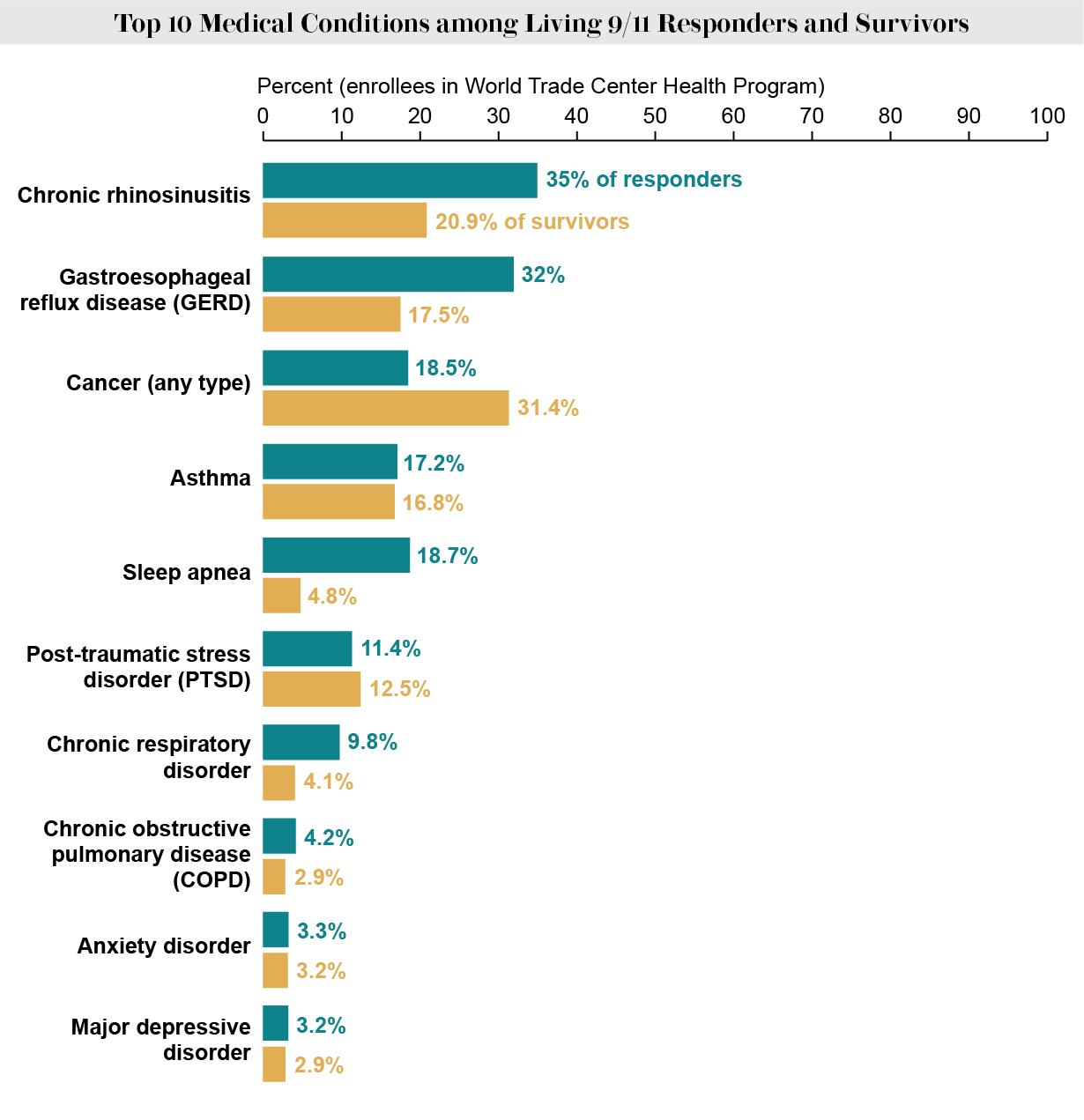
Many of these hundreds of thousands of Americans live with the memory of 9/11 every single day, not just once a year when the anniversary rolls around. The health effects from environmental exposures in the days and months after the attack linger—or develop anew as cancers begin to form. About 74percent of responders in the WTC Health Program have been diagnosed with at least one physical or mental health condition directly linked to 9/11 exposure, including 20 percent with cancer and 28 percent with a mental health condition. The two most common conditions among enrolled responders are chronic rhinosinusitis, or nasal inflammation, and gastroesophageal reflux disease (GERD), followed by cancer—particularly prostate cancer because 87 percent of living responders are male—asthma, sleep apnea and post-traumatic stress disorder (PTSD).
“We worked there, we slept there, we went to bed there, we ate there, we cried there,” Feal says. “The absorption through the nose, mouth and skin of those toxins made us sick.” During the first decade after the attack, he says, he and other responders, researchers and supporters had to fight to prove those health effects were real.
“We said we were sick from 9/11,” Feal says. “They [members of Congress] said we were making it up, it was in our heads, we were crazy. But we’re a finite number, and with these life-altering illnesses, we were dying off quicker than we were supposed to.”
The long-term health impacts were no surprise to epidemiologists such as Christine Ekenga, an assistant professor of environmental health at the Rollins School of Health at Emory University, who studies the health impacts of disasters and has authored several studies on the effects of 9/11.* “Long-term physical and mental health impacts were always a concern among clinicians and health researchers during those early years, and we did anticipate that there would be 9/11-related deaths long after the disaster,” she says.
Today the link between 9/11 and a long list of chronic health problems is indisputable. The WTC Health Program has a list of conditions it will cover that research has definitively linked to 9/11 exposures. And the federal James Zadroga 9/11 Health and Compensation Act, signed into law in 2011 and reauthorized in 2015, ensures that funding will cover care for those conditions through 2090.
Nearly half of living responders have a respiratory or digestive condition related to 9/11, and 16 percent have developed a cancer. Another 16 percent have a mental health condition, such as PTSD, depression or substance abuse. The WTC Health Program covers all of these ailments, as well as musculoskeletal conditions that developed on or after 9/11.
Among the hardest hit groups were members of the New York City Fire Department (FDNY), a cohort that includes more than 15,000 firefighters, emergency medical services staff and civilians enrolled in the WTC Health Program. FDNY lost 343 people on 9/11, but more than 200 have died since, according to Rachel Zeig-Owens, director of epidemiology for the WTC Health Program at FDNY. Even two decades after the attacks, 9 percent of FDNY veterans of 9/11 still have PTSD, and 18 percent have depression.
“Most of the fire department was exposed to the heavy dust right at the beginning, and they were invested in trying to help find everybody and do the rescue and recovery work,” says Zeig-Owens, who is also an assistant professor of epidemiology at the Albert Einstein College of Medicine. Few of them used respirators or other essential personal protective equipment in the early weeks. The appropriate respirators were not available until a week after cleanup began. Even then, they were bulky and difficult to wear, and they impeded communication. The average time FDNY employees and retirees spent on site was three to four months, although some spent the whole 10 months at Ground Zero until cleanup concluded in July 2002.
One of Zeig-Owens’s key findings that lent evidence to the link between long-term impacts and 9/11 exposures was the dose-response effect. The most common conditions, GERD and upper and lower respiratory disease, each occur among more than 40 percent of FDNY workers, and those who arrived on-site earliest have the highest rates of respiratory disease.
Prostate cancer rates in FDNY members began to increase after slightly more than five years post-9/11—much sooner than the 10- to 20-year increase seen in studies of populations that were not exposed to Ground Zero. Researchers also found that rates of prostate cancer correlated with greater levels of exposure.
Similar evidence is building for conditions that are not yet covered under the WTC Health Program, including heart disease, some autoimmune diseases (especially lupus), hearing problems, and neurological and cognitive conditions. For example, workers who arrived on the morning of 9/11 were 38 percent more likely than those who arrived later in the day or later that week to have a stroke, heart attack or other cardiac event in the years since.
Research on the FDNY cohort also reveals the challenges of disentangling how 9/11 exposures have and have not contributed to different conditions, however. For one thing, FDNY members had better baseline health and tended to have a healthier lifestyle than their peers at the time of the attacks. Only 4 percent of them smoked, a much lower rate than New York City’s general population (although about a third were former smokers). Being healthier to start with may partly explain why FDNY members and other responders enrolled in the WTC Health Program were 34 percent less likely to die of cancer than expected during the past two decades, with particularly reduced mortality rates for colon and prostate cancer. But as members of the WTC Health Program, they also have better access to health screenings and high-quality care. Such benefits mean faster identification and treatment of cancers than the general population.
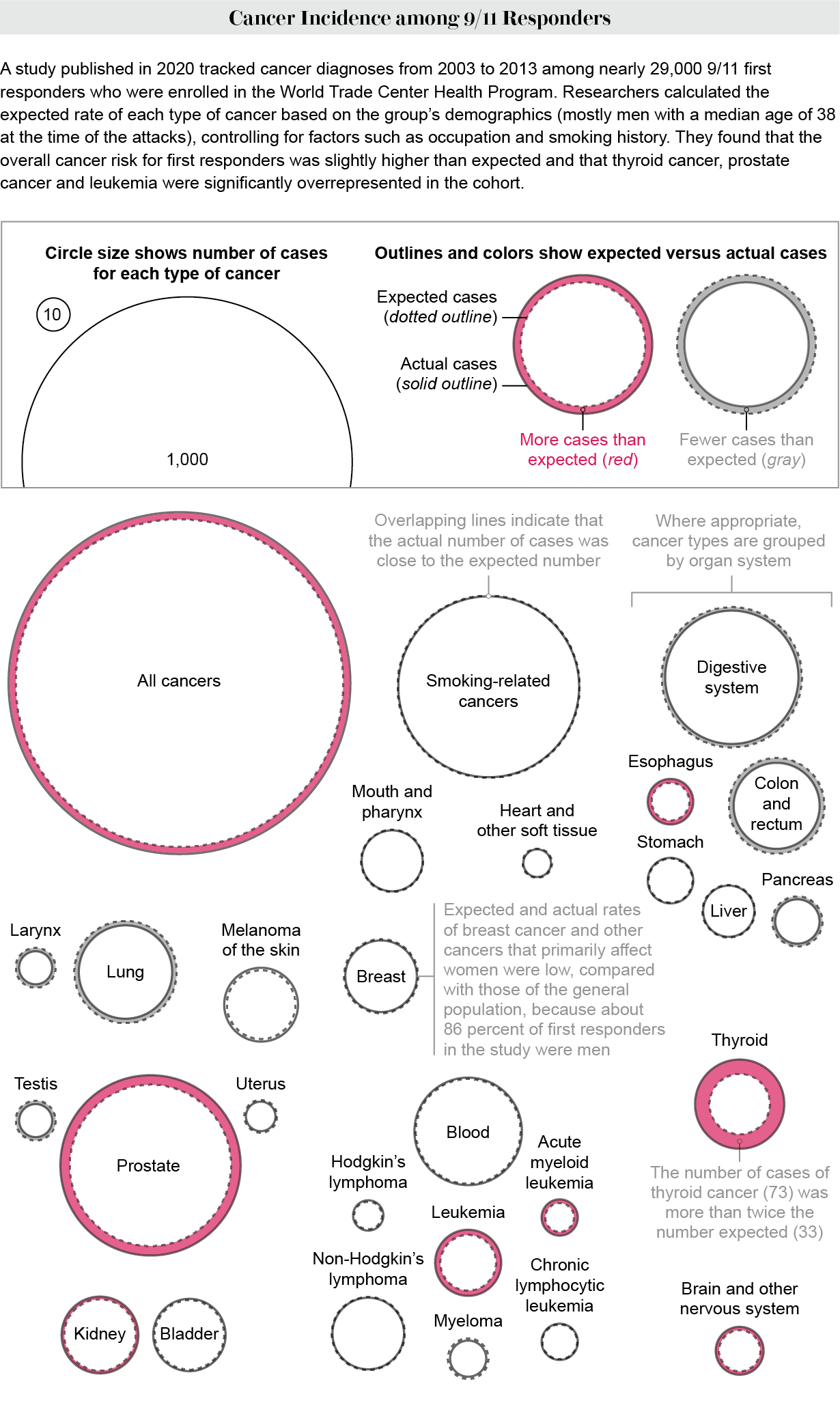
The increased screening may actually explain the higher rate of at least one of the cancers. For example, FDNY members who were 9/11 responders have a greater risk of thyroid cancer than the general population, yet Zeig-Owens’s research has found that asymptomatic cases accounted for the excess risk, suggesting that rates were higher in this population because of better health screenings. Regular computed tomography (CT) imaging and chest x-rays for cancer picked up more incidental cases before symptoms appeared. FDNY members had higher thyroid cancer rates because they were in a program that looked for cancer more often.
Other questions remain unanswered. GERD, one of the most common long-term effects of Ground Zero exposure, can lead to Barrett’s esophagus, which can develop into esophageal cancer. Currently, Zeig-Owens says, her team is not seeing higher rates of this cancer in the FDNY cohort, but “it may just be a waiting game.” It can take 10, 20, or more years after an exposure for cells to develop into cancer. The average age of FDNY responders on 9/11 was 40, and most responders are now in their 50s and 60s, when cancer risk begins rising as a result of age.
Researchers continue to try to parse out what cancers are developing because of natural aging versus those occurring as a result of 9/11 exposure. A study published in the February 2020 issue of JNCI Cancer Spectrum, for example, compared the incidence of different cancers among 9/11 responders and found a surprising lower rate of lung cancer but an elevated risk of leukemia. “The complex relationship between exposure and cancer development is not fully understood,” says Shapiro, who led the study. But his team has some hypotheses. “Leukemia is associated with exposure to benzene, present in [high] quantity from burning jet fuel at the World Trade Center site,” he says.
Despite the growing list of lingering 9/11 health concerns, the research has uncovered some encouraging findings, such as a lower risk of death from cancer. One recent study identified the factors that play the biggest role in 9/11 responders’ risk of developing lung disease, as well as ways to reduce that risk, such as losing weight and reducing cholesterol.
Now that scientists better understand the effects of this tragedy, “we’re mostly focused on how to help people improve,” says Anna Nolan, a professor of environmental medicine at the NYU School of Medicine, who conducted the lung disease risk study with Zeig-Owens and their colleagues. “Body mass index and lipids are much riskier to these patients than even smoking history, and I think that’s really important” because those risk factors can be changed, she says.
The research on the tragedy’s aftermath can help public health experts and policy makers better understand health effects from other human-made and natural disasters.
The more researchers examine the mechanisms by which particulate matter during the 9/11 cleanup led to inflammation and various health conditions, “the more you realize the similarities to other ambient and urban exposures,” including wildfires, Nolan says.
Feal, for his part, has not wavered in his mission to find those who have slipped through the cracks to help them enroll in the WTC Health Program. And he has continued to honor those who have died by memorializing them in the park on Long Island that the FealGood Foundation helped build.
The COVID-19 pandemic has complicated that aim, and it has taken its own toll on 9/11 survivors. Feal, who says he has “never been afraid of anything in my life ever,” experienced a bout with COVID that terrified him. “I thought I was going to die,” he says. About 100 9/11 survivors have perished from the disease, often alone in the hospital, Feal adds.
But even once the pandemic’s immediate danger passes, 9/11’s impacts will endure. “The further we get away from 9/11, the more these men and women suffer, and we want to comfort them because the next 20 years are going to be a lot worse than the first 20 years,” Feal says. Research supports his prediction.
“Since that terrorist attack 20 years ago, we’ve seen a lot of manmade and natural disasters, and it takes a special breed of people to run toward [them] while others are running away,” Feal says. “These people were truly the best of the best. They were our nation’s greatest resources. They gave hope to a broken city and to a lost country. And we need to do a better job of helping these men and women.”
*Editor’s Note (9/10/21): This sentence has been edited after posting to correct Christine Ekenga’s current title and affiliation.
California gubernatorial candidate Larry Elder responds to a hateful attack against him by a woman wearing a gorilla mask while on a campaign stop. In an interview on Thursday, Elder said if he were a liberal and attacked by a white woman, the left would be screaming about systemic racism.
In a separate tweet, he stressed “the intolerant left will not stop us” from recalling embattled Gov. Gavin Newsom (D-Calif.). Elder pointed out the incident was much worse than it seems because his staffers were also allegedly attacked.
Today I kicked off the Recall Express bus tour. Before we even left Los Angeles, my security detail was physically assaulted, shot with a pellet gun, and hit with projectiles. The intolerant left will not stop us. We will recall Gavin Newsom. We will save California.
Additionally, Elder said the attackers falsely accused him of not caring about Black people. However, the candidate pointed out a major goal of his campaign is to tackle homelessness, which disproportionately affects Black Californians.
This comes as the sheriff of Los Angeles called out the woman who attacked Elder. In a tweet on Thursday, Alex Villanueva asked why the incident wasn’t considered a hate crime. He then continued on to answer his own question saying “because woke privilege means a white woman can wear a gorilla mask and attack a Black man without fear of being called a racist.”
Meanwhile, the Los Angeles Police Department reported that while no charges have been filed, the investigation is ongoing.
The president earlier signed executive orders mandating that all federal workers get vaccinated if they want to keep their jobs. Another order signed by the president requires private federal contractors and sub-contractors to vaccinate their employees as well, with an additional mandate reported to be still in the works.
US President Joe Biden has lambasted the Republican governors and politicians who criticized his recent introduction of vaccination mandates and who have vowed to challenge them in court. POTUS dared them to “have at it”, apparently ready to fight in defense of the policy, which is part of a broader White House strategy to combat surging COVID-19 cases.
“I am so disappointed. Particularly, some Republican governors have been so cavalier with the health of these kids, so cavalier with the health of our communities. This isn’t a game.“
Joe BidenUS President Biden went on to justify the mandates by claiming that a majority of Americans support mass vaccination and added that the move to make them compulsory for the overwhelming amount of US citizens was “hard but necessary”.
Republicans Criticise Biden’s Vaccination Move, Threaten With Lawsuit
The president thus responded to numerous critical voices from the GOP, with many of them condemning the vaccination mandates as illegal and unconstitutional. “Joe Biden told Americans when he was elected that he would not impose vaccine mandates. He lied. Now small businesses, workers, and families across the country will pay the price”, RNC chair Ronna McDaniel, who describes herself as “pro-vaccine and anti-mandate”, said.Republican National Committee’s (RNC) head Ronna McDaniel followed up on her statement, announcing that the RNC plans to sue Biden over the vaccination mandates, citing the impact it might have on the private sector.
Georgia Governor Brian Kemp said he would explore “every legal option available” in order to strike down the vaccine mandates, while Arizona Governor Doug Ducey said the move was a sign of a “dictatorial approach” on the part of Biden and that the mandate was “wrong” and “un-American”.
Many Republicans took issue with Biden’s words about vaccination no longer being “about freedom, or personal choice”, but about “protecting yourself and those around you”. A spokeswoman for the Florida governor, Christina Pushaw, said that the remark was “the most disturbing thing I’ve ever heard a politician say”. GOP Senator Ted Cruz, in turn, accused Biden of ignoring science and attacking Americans’ right to privacy.
In his 9 September address, President Joe Biden stated that enough time and evidence of vaccine safety had been given for people to vaccinate voluntarily. POTUS noted that vaccinated Americans had been “patient” enough and that the refusal of others to get jabs has “cost all of us”. Biden thus issued two executive orders that mandated federal workers, contractors and sub-contractors to vaccinate against COVID-19 without an alternative of routine weekly testing. The president also revealed that another order was still in the works to mandate all businesses with over 100 employees to either vaccinate them or demand that they present the results of the COVID-19 test weekly.
Ben Shapiro, founder and editor emeritus of The Daily Wire, announced Friday morning his company will “use every method and resource at our disposal to defy the president’s unconstitutional order.”
The announcement from the conservative author and business owner came one day after President Joe Biden delivered a speech declaring his administration is mandating all private sector employers with more than 100 staffers require their workers to get vaccinated against COVID-19 or test for the virus every week — a far-reaching order many argue is outside the purview of the president’s powers.
🚨🚨@BenShapiro announced on @FoxNews this morning that @realDailyWire will not comply with Joe Biden's vaccine mandate targeting businesses.
"We're going to use every method and resource at our disposal to defy the president's unconstitutional order." pic.twitter.com/7kGxwycpmh
“Of course not,” Shapiro said after Fox News’ Steve Doocy asked if The Daily Wire will comply with Biden’s latest edict. “We’re going to use every method and resource at our disposal to defy the president’s unconstitutional order, and this is coming from somebody who is very pro-vaccine. I was vaccinated as soon as possible and I’ve encouraged everybody to get the vaccine — pretty much everybody to get the vaccine.”
“[Biden] came into office saying, ‘I’m not gonna shut down the economy, I’m not gonna shut down the country, I’m going to shut down the virus,’” he continued. “He failed to shut down the virus, so now he’s going to shut down the country, apparently.”
The president said those who don’t comply with his vaccine mandate will face $14,000 fines for each violation. In response, Daily Wire CEO Jeremy Boreing announced that, although the conservative media outlet does employ more than 100 people, it has no plans to fall in line with Biden’s “unconstitutional and tyrannical vaccine mandate.”
Shapiro, for his part, told Fox News’ Ainsley Earhardt that The Daily Wire “is staffing up on the legal side and is “already getting any lawsuit ready” to fight the White House.
“I think he’s made a huge tactical legal blunder here,” he explained. “I think there’s every possibility that something like this goes to the Supreme Court level and suddenly we see a complete re-writing of the administrative state because Joe Biden couldn’t get his act in order and decided to issue a tyrannical and authoritarian order here.”
The popular podcaster went on to argue he believes the political maneuvering is a result of Biden’s various “failures” in less than one year.
“We’re not even a year into this presidency and this is a failed president on every level,” Shapiro said. “And so he’s attempting to redirect all of the ire at his presidency at your fellow Americans. You’re supposed to be angry at your neighbor [being] unvaccinated if you’re vaccinated, even though Joe Biden yesterday said you’re unvaccinated neighbor effectively poses no threat to you. Instead, Joe Biden wants you to be angry at that neighbor as opposed to him.”
Radio host Stew Peters exposed the controversy behind Trump’s endorsements.
President Donald Trump’s political endorsements are reportedly being sold off by Bill Stepien, potentially without President Trump’s knowledge, according to top radio host Stew Peters.
In lieu of President Donald Trump’s recent and questionable endorsements, radio host Stew Peters reported that the former President’s endorsements are being sold off by Bill Stepien – potentially behind his back.
The news comes after President Trump endorsed Harriet Hageman’s bid to replace Rep. Liz Cheney, the anti-Trump representative from Wyoming who voted to impeach him. Hageman, however, was described to National File as Cheney’s “BFF,” or “best friend forever,” has had family connections to the Cheney family that go back decades, and worked on Cheney’s failed 2013 Senate campaign as a political advisor.
Despite running against Cheney, when Hageman launched her campaign yesterday, her own website had photographs of her posing with the anti-Trump Republican and Cheney’s father, former vice president Dick Cheney. Additionally, until yesterday, Hageman’s Facebook revealed that she was spending time with Cheney on election day in 2018, despite having her own race for governor that she lost.
“I can report today that I have spoken with somebody very close to President Trump, and that person says that one of the President’s closest aides, Bill Stepien, is selling the President’s endorsements for money,” said Peters. “Now to be clear, this person says Trump does not know about this and I don’t know the exact form this quid pro quo took, but the overall thrust was clear: Bill Stepien is arranging for President Trump to endorse candidates for reasons other than actual politics.”
“That would explain the out of nowhere choice of Harriet Hageman,” Peters added. Despite Harriet Hageman being described to National File as Rep. Liz Cheney’s “best friend forever” and Hageman having worked for Cheney as recently as 2013, and Hageman’s ties to a 2016 effort to strip President Trump of the Republican nomination for president, Hageman received an endorsement from the 45th President this week.
“Bill Stepien was the guy who managed Trump’s campaign in the final five months of the 2020 race. In other words, this is the guy, Bill Stepien, who botched what should have been a sure thing,” said Peters. “But he personally made a lot of money doing it, and now he gets to make more on the 2022 races.” Peters added, “This guy wins, even when America First loses,” said Peters.