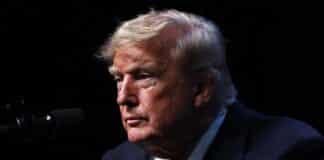
President Donald Trump held a press conference Wednesday at the G7 summit in France, defending a 14-point memorandum of understanding his administration has reached with Iran to end the war. The agreement is set to be signed in person by both sides on Friday.
Trump has refused to release the text publicly before signing. But Bloomberg and CNN reported Wednesday that they had obtained a draft of the document. White House communications director Steven Cheung pushed back. “The reported text does not reflect the language of the actual MOU,” Cheung said.
Trump confirmed he would resume military operations if Iran fails to comply with the deal’s terms. “We’re not going to stop if they don’t behave,” he said at the press conference.
The reported agreement would end hostilities “on all fronts,” including Lebanon, where Israel has been fighting to neutralize Hezbollah. Israeli Prime Minister Benjamin Netanyahu has been kept out of the U.S.-Iran negotiations entirely. Israel has stated it will not withdraw forces from border regions of Lebanon and maintains the right to defend itself against Hezbollah.
Shipping through the Strait of Hormuz would be restored within 30 days of signing. The U.S. would lift its naval blockade immediately, while Iran would commit to clearing mines and removing “technical obstacles” from the waterway.
The MOU would commit the United States and its regional partners to ensuring at least $300 billion in financing for an Iranian reconstruction fund. Trump said Wednesday the U.S. would not contribute directly to the fund. “I can’t stop other countries from investing in Iran,” he said.
On sanctions, the agreement calls for the U.S. to end “all types of sanctions” on Iran as part of a final deal, including sanctions approved by the United Nations and the International Atomic Energy Agency, along with unilateral American sanctions.
The nuclear provisions have drawn the sharpest scrutiny. Iran reiterates under the deal that it will not produce nuclear weapons, a commitment it also made under the Obama-era nuclear agreement. But the MOU does not explicitly ban uranium enrichment. Instead, it maintains the “status quo” of Iran’s nuclear program. The fate of Iran’s stockpile of weapons-grade uranium is left to a final agreement.
Trump called that provision a 99.9 percent solution. “This achieves 99.9 percent of my goal,” he said.
The Treasury Department would immediately issue waivers for Iranian crude oil exports, petrochemical products, and related banking, insurance, and transportation services, according to the reported text. Frozen Iranian funds and assets held abroad would also be unfrozen as negotiations progress, with no restrictions specified in the MOU on how those funds could be used.
Critics of the deal say the immediate oil sanctions relief gives Iran an economic lifeline that allows the country to begin rebuilding its military before making any definitive concessions on nuclear activity.
The two sides have 60 days to finalize the full agreement, with the window “extendable by mutual consent.” Any final deal would require approval through a binding U.N. Security Council resolution. Trump said Tuesday he would also send a final agreement to Congress for a vote.
Vice President JD Vance said Iran’s access to funds would be conditioned on its willingness to make further concessions during the 60-day window.