


SCOTUS Lets Texas Six Week Abortion Ban Stand
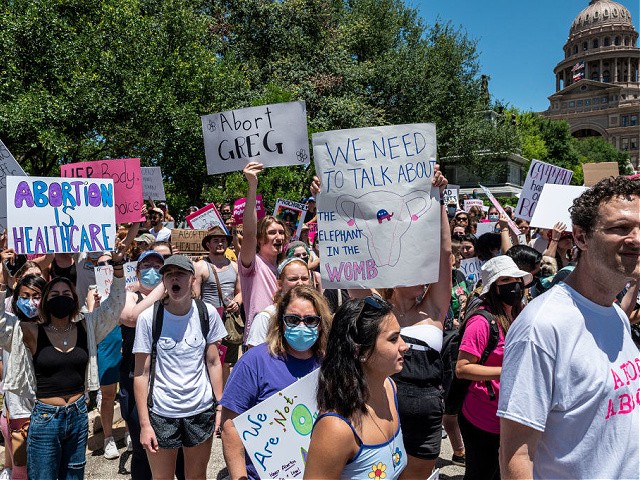
In a pro-life victory, the Supreme Court of the United States ruled 5-4 on Wednesday not to block the new Texas law banning most abortions after six weeks of pregnancy while legal challenges to that law proceed in lower courts.
A narrow majority of justices held that the abortion-provider plaintiffs had failed to meet the high standard required for the Supreme Court to issue an injunction blocking a law before it goes into effect.
Signed in May by Texas Gov. Greg Abbott (R), Senate Bill 8 effectively bans abortions in the Lone Star State the moment a fetal heartbeat is detected, which often occurs after six weeks of pregnancy. Since women do not often detect pregnancy prior to the sixth week, the law effectively bans abortions in the state. Multiple states have tried to implement similar measures only to be blocked by the courts.

The five-justice majority of Justices Clarence Thomas and Samuel Alito, and Trump-appointed Justices Neil Gorsuch, Brett Kavanaugh, and Amy Coney Barrett did not issue a published opinion with their decision, so the precise reasoning of the Court remains unclear, including whether the Texas law would survive a constitutional challenge on the merits when that question is squarely before the Supreme Court.
“The applicants now before us have raised serious questions regarding the constitutionality of the Texas law at issue,” Chief Justice John Roberts wrote in dissent. “But their application also presents complex and novel antecedent procedural questions on which they have not carried their burden.”
Roberts explained that he was dissenting because an injunction would freeze the status quo while the courts work through whether Texas’s law violates a constitutional right to abortion, narrowly leaving open the possibility that he could vote in favor of the law down the road.
The three liberal justices, Stephen Breyer, Sonia Sotomayor, and Elena Kagan issued strongly worded dissents against the Lone Star State’s law.

Legal proceedings in the lower courts might not move forward until a citizen attempts to enforce it against an abortion provider, leaving the pro-life measure in effect indefinitely. The Supreme Court will also hear a major abortion case this term, Dobbs v. Jackson Women’s Health, and it’s possible that this case and other abortion cases will be held in abeyance until the Supreme Court renders a decision in that case.
The case is Whole Woman’s Health v. Jackson, No. 21A24 in the Supreme Court of the United States.
WHO Issues Guidance On Digital COVID Certificates Called ‘Conspiracy Theory’ By Media.
A newly published World Health Organization (WHO) report urges the transition to digital certification of vaccine status, presenting implementation strategies for member states.
The report is labeled as “interim guidance” which should serve countries help in their fight against COVID-19 and “to capture vaccination status to protect against other diseases”.
The central premise appears to be the implementation of Digital Documentation of COVID-19 Certificates (DDCC) which will act as an agent to present and review vaccination status, history of SARS CoV-2 infection and test results. The report acts as a technical guidance, in regard to infrastructure, digital verification processes, and “ethical standards”.
The executive summary states:
In the context of the coronavirus disease (COVID-19) pandemic, the concept of Digital Documentation of COVID-19 Certificates (DDCC) is proposed as a mechanism by which a person’s COVID-19-related health data can be digitally documented via an electronic certificate A digital vaccination certificate that documents a person’s current vaccination status to protect against COVID-19 can then be used for continuity of care or as proof of vaccination for purposes other than health care. The resulting artefact of this approach is referred to as the Digital Documentation of COVID-19 Certificates: Vaccination Status (DDCC:VS).
The main uses of DDCC – as reflected in the report – are:
- Continuity of care – record of vaccination – to inform individuals and health care workers when and what type of vaccine should a person receive (in the future).
- Proof of Vaccination – vaccination status for purposes not related to health care, such as University education, travel, survey participation.
The report also describes how vaccination should lead to different steps of verification and database administration, after the person receives the vaccination. The certification would transition through security verification steps until a digital certification is generated. Despite the detailed description of various verification steps, the report never signifies the reason why digital verification is needed and why nation states should follow the process to implement a whole new infrastructure. The only stated downside of paper-based verification is potential fraud.
Proof of Vaccination.
Furthermore, the report signifies scenarios where people have “to prove their COVID-19 vaccination status (such as care site, a school, or an airport).”, despite this policy being implemented in only a few places such as New York, France, and Italy.
Data sets & Structures.
The report states that bare minimum information should be included in the identification process. However, the WHO also lists mandatory, new data points that need to be linked to the vaccination status:
- Name;
- Date of Birth;
- Unique Identifier (National ID, Health ID etc.);
- Sex;
- Vaccine type;
- brand;
- manufacturer;
- market authorization holder;
- batch number;
- date of vaccination;
- Vaccination valid from;
- dose number;
- total doses;
- country of vaccination;
- administering center;
- signature of health worker;
- health worker ID;
- disease targeted (name of the disease that vaccine given to protect again);
- Due date of next dose;
- certificate issuer;
- health certificate ID;
- certificate valid from;
- certificate valid until;
- certificate schema version.
Implementation.
The certification would “help” member states either as short-term solution or long-term. In the case of short-term solution, the report suggests the usage of certification until COVID-19 is no longer considered a public health emergency.
Member states, however, can also keep the system to address other pandemics and “to build digital health infrastructure that can be a foundation for digital vaccination certificates beyond COVID-19…”
The report id funded by the Bill and Melinda Gates Foundation, the Government of Estonia, Fondation Botnar, the State of Kuwait, and the Rockefeller Foundation.
President Trump Releases New Ad Slamming, Exposing Biden Regime, Failures In Afghanistan
President Donald Trump has released a new advertisement about Joe Biden and the Afghanistan Disaster.
President Donald Trump has released a new advertisement exposing the Biden regime’s mishandling of the Afghanistan disaster.
As America reels from Joe Biden’s disastrous Afghanistan withdrawal, President Donald Trump has released a new advertisement exposing the failures of the Biden regime over the sad situation that they caused in the Middle East. “A heartbreaking loss for the United States and it’s great Military. We must have hostages released and our Military equipment returned, NOW!” President Trump said in a statement.
The video shows how wrong Biden was about Afghanistan not becoming a “terrorist base” by revealing news reports now describing the region as “Disneyland for terrorists.”
The heartbreaking chaos in Afghanistan is on full display in the new video released by President Trump. The video shows children crying, crowds of panicked Afghan citizens, Taliban militants, with “IT’S A FAILURE” flashing on the screen.
Biden however, recently said that the debacle was an “extraordinary success” despite effectively handing over billions of dollars worth of US military equipment to the Taliban, the abandonment of thousands of American citizens and military dogs, the deaths of 13 US service members, and the diminishing of American global standing, as National File previously reported.
President Trump, widely critical of how the Afghanistan War came to its end, issued a warning to the American people that the disaster could lead to a 9/11-style attack on American soil in the future.
President Donald Trump made an appearance on One America News Network for a sit down interview with Real America host Dan Ball to discuss the state of America when he was in office compared to how things are now under Joe Biden. The two discussed Biden’s Afghanistan Disaster, Biden’s Border Crisis, and the possibility of another 9/11-style attack occurring on US soil in the near to distant future.

California’s State Pension Invests Millions in Chinese State-Owned Companies
CalPERS has $490 million tied up in companies funding Belt and Road
California’s state pension invested hundreds of millions of dollars in Chinese state-owned enterprises linked to the People’s Liberation Army, according to records reviewed by the Washington Free Beacon.
The California Public Employees’ Retirement System (CalPERS) had more than $3 billion invested in Chinese companies, including 14 state-controlled enterprises blacklisted by the Trump administration, as of June 2020. Many of these companies are funding the Belt and Road Initiative, a massive infrastructure project Beijing is using to expand its geopolitical and military influence.
Gov. Gavin Newsom (D., Calif.), who recently praised a Chinese-owned media company for its “journalistic integrity,” has not commented on CalPERS’s Chinese investments. It is a notable silence from the embattled governor, who has called on CalPERS, the country’s largest public pension system, to divest from tobacco companies and companies linked to the Turkish government. Newsom faces a recall election on Sept. 14.
CalPERS had more than $450 million invested in 14 Chinese companies the Trump administration put on an investment blacklist last year because of their ties to the Chinese military. President Donald Trump’s executive order, which the Biden administration has continued, prohibited Americans from investing in companies that aid the Chinese military.
It is unclear whether CalPERS has complied with the executive order by divesting in the blacklisted companies. The pension fund declined the Free Beacon‘s requests for comment. CalPERS had more than $490 million invested in seven Chinese state-owned enterprises that, while not on the U.S. blacklist, are funding the Belt and Road Initiative, according to its 2020 investment report. CalPERS invested in some of the Chinese companies as early as 2016, records show.
Two companies in the CalPERS portfolio—China Merchants Port and CITIC—control ports in Sri Lanka and Myanmar that the People’s Liberation Army has used for military exercises. CalPERS had $3.7 million invested in China Merchants Port and $110 million in CITIC as of June 2020.
CalPERS, which has more than $400 billion in assets under management, also had $5 million invested in China State Construction Co., which has built roads and bridges in Asia, Africa, and the United States as part of Belt and Road. China State Construction is one of the firms on the Trump administration investment blacklist.
CalPERS had another $6 million invested in China Communications Construction Company, a state-owned company that U.S. officials have said is building military installations in the South China Sea in violation of agreements that China has with its neighbors. Former secretary of state Mike Pompeo singled out China Communications Construction last year as one of the “weapons” Beijing uses to impose an expansionist agenda.
The pension fund has hundreds of millions of dollars more invested in some of China’s largest lenders, including $185 million invested in China Construction Bank. China Construction has invested $405 billion in 176 Belt and Road projects. China Merchants Bank and Bank of China, two other state-owned enterprises in the CalPERS portfolio, are invested heavily in Belt and Road projects.
CalPERS has come under scrutiny from state and national lawmakers over its investments in Chinese companies. The fund’s critics say the investments not only aid the Chinese Communist Party but also create financial risk for the state’s pensioners because of the lack of transparency into the operations of Chinese firms.
“CalPERS would do well on its own to reconsider some of its billions of dollars of investments in China just for the fact that immediate international turmoil produces large uncertainties for California retirees,” said Lance Christensen, the chief operating officer at the California Policy Center, a conservative think tank.
Some investment managers are reportedly reconsidering investments in China because of the government’s crackdown on tech companies and other for-profit companies. Chinese companies listed on U.S. stock exchanges lost $400 billion in value in July amid a series of regulatory crackdowns orchestrated by the Chinese government, the Wall Street Journal reported.
CalPERS’s former head under Newsom, Ben Meng, is an American citizen of Chinese origin. Prior to leading CalPERs, he worked in China as the deputy chief investment officer of China’s State Administration of Foreign Exchange. In that role, he oversaw $3 trillion of foreign-exchange reserves.
During Meng’s time at CalPERS, Rep. Jim Banks (R., Ind.) criticized Meng’s membership in China’s Thousand Talents Program, which the nation uses for espionage. Banks wrote to Newsom suggesting the governor fire Meng, a power Newsom does not technically have.
“Governor Newsom, if it were up to me, I would fire Mr. Meng immediately,” Banks wrote in a February 2020 letter. Banks took specific issue with Chinese companies like Hikvision, for example, that are used by China to further its detention of Uyghurs. CalPERS responded by calling Banks’s letter a “politically opportunistic attempt to force us to divest, undermining our ability to perform our fiduciary duty to provide retirement security to California’s public employees.”
Last year, Banks and Sen. Rick Scott (R., Fla.) called on Newsom and CalPERS to divest from Chinese state-owned companies. CalPERS rejected the requests, saying that its portfolio largely mirrors investments in the MSCI and FTSE stock indices. MSCI has said it is divesting from the 14 companies on the federal blacklist, but it is not clear whether CalPERS plans to follow MSCI’s lead.
While Newsom does not directly control CalPERs, he has actively used his bully pulpit as a statewide elected official to force the agency’s investment decisions in the past. In 2019, he signed an executive order directing CalPERS and other state pension funds to invest in green energy companies in order to fight climate change.
In 2016, then-Lt. Gov. Newsom urged CalPERS not to reverse a decision to prohibit investment in tobacco companies. He said CalPERS would be “investing in death” if it allowed investments in Big Tobacco. CalPERS voted later that year to expand its prohibition on tobacco investments.
As a gubernatorial candidate in 2018, Newsom called on CalPERS to divest from Turkish companies because of the regime’s refusal to recognize the mass murder of Armenians in 1915.
“It is wrong of us as a state … to invest in Turkish businesses. It’s time for divestment at the [University of California] and CalPERS,” Newsom said at a rally outside the Turkish consulate in Los Angeles.
Newsom has not made a similar demand of CalPERS regarding China, even though both the Trump and Biden administrations have said that the government is carrying out genocide against Muslims in Western China.
“Gov. Gavin Newsom is quick to leverage his position on issues like climate change by outlawing gas-powered cars or other similar mandates, but slow to speak out on government investments in China, where their environmental and labor record is abysmal,” said Christensen, the official at the California Policy Center.
Newsom’s office did not respond to requests for comment.