A video released by the group Campus Reform on Thursday shows young people, many of them ironically standing in front of the nation’s Capitol, being asked what the American flag means to them.
The reporter, Ophelie Jacobson, then shows them pictures of the recent protests in Cuba, and other places around the world like Hong Kong and Venezuela, and asks those being interviewed why people in other nations would be flying American flags.
The answers were not only a chilling display of the massive failure of the America education system, but how America’s young people are being taught to hate America.
What we got is a generation that is being taught that is America is not an exceptional place, that it is a place full of racism and hate, and should not be held up as an example.
When asked what the American flag means to them, one woman said, “Shame, I felt like if I had the American flag and was associated with the American identity, I would be associated with a lot of bigotry, racism and sexism.”
Another student, a young African-American woman, said of the flag, “It’s a symbol of hurt.” When asked if the American flag is a symbol of freedom and liberty, most of the students said no.
One person – just one – said he thought the American flag symbolized “peace, prosperity, and freedom.”
As if that isn’t frightening enough, Ophelie Jacobson then showed the students pictures of the ongoing protests in Cuba, in Hong Kong in 2019, and Venezuela. It was obvious they had no clue why these people would be flying American flags.
One student remarked, “I mean we don’t represent a socialist government…so I don’t know why they would wave the flag. I’m not sure honestly.”
Another student said, “That’s a good question. It’s interesting to see them all decked out in American flags and everything.”
Interesting, like some oddity standing next to the 8 foot tall man and the bearded lady at the roadside carnival. Insert mandatory eye roll here.
— All American Girl (@AIIAmericanGirI) July 16, 2021
They Just Don’t Know What’s Really Going On
While a few of the students ventured a guess that it could be that Cubans were flying American flags because it is a symbol of freedom, another student said that, “the stigma is that you come to America, you get everything you want, but then you come here and it is actually a lot different. You have to work for your stuff.”
Wow.
This girl said she was from Ukraine. Come to America and get everything you want? Let’s hope Hunter Biden is not the poster child for immigration to the U.S. in Ukraine.
The idea being, these people waving American flags are just naive and don’t really know what’s going on in America.
One young man even said that, of course it is “our demographic, it’s college age people who have a firm understanding of what’s going on and all the inequities in America.” Our African-American young lady friend said no country should be put on a pedestal.
Ok. Your humble correspondent here likes to think I remember what it was like to be young.
You are smart, with it, on the ball, you have all the answers. This may be where I officially turn into my parents, but newsflash, snot-nose.
No, it is NOT your demographic that has a firm understanding of what’s going on.
Your demographic eats Tide pods and is not sure which bathroom to use. The reason Cubans flying American flags is a mystery to you? Call the MENSA people.
"Princeton course offers what it presents as solutions to combat the ‘racial biases built in tech’" such as soap dispensers and facial recognition.
— Leadership Institute (@LeadershipInst) July 12, 2021
Liberal Enclave Washington D.C.
In all fairness to these idealistic young people, they live in a hugely liberal city. Citizens of Washington D.C. voted for Hillary Clinton in 2016 and Joe Biden in 2020 by overwhelming margins.
Literally overwhelming. Both Hillary and Biden cleared 90+% of the vote.
And they are listening to a media that studies show is increasingly liberal as well. Combine this with what we know about the ratio of liberal to conservative professors on college campuses, and it’s no wonder.
These young people have no idea of the misery, extreme poverty, and terror that six decades of socialism and communism have wrought on the Cuban people.
These people apparently have no knowledge of refugees being crammed into rickety boats and life rafts, making the 90 mile journey through shark infested waters to America because they are so desperate for freedom.
One of the young women interviewed had this assessment of the flag those making the trip referenced above see as a symbol of freedom and liberty: “No, I don’t think America is as free as people think it is. It is just a piece of cloth at the end of the day.”
The tangled web of voter reform laws, the Trump voter fraud accusations, and the Secretary of State Office’s findings show why we need more digging on what happened in Georgia.
During a detailed discussion with The Federalist on Wednesday, representatives from the Georgia Secretary of State’s office provided their perspective on new evidence suggesting more than 10,300 Georgian voters illegally cast ballots in the November 2020 general election.
Last week, The Federalist reported on recently obtained data indicating tens of thousands of Georgia voters had violated Section 21-2-218 of the state’s election code, which requires residents vote in the county in which they reside, unless they had changed their residence within 30 days of the election.
Shortly after the November 2020 election, Mark Davis, the president of Data Productions Inc. and an expert in voter data analytics and residency issues, determined from National Change of Address records that nearly 35,000 Georgia voters who indicated they had moved from one Georgia county to another voted in the 2020 general election in the county from which they had moved.
Kurt Hilbert, one of President Trump’s lead attorneys in the Georgia case, told The Federalist that this category of potentially illegal votes served as one of the 33 categories of voting irregularities underlying the president’s challenge to the Georgia election results. Specifically, in his 64-page complaint accompanied by thousands of pages of sworn affidavits and expert reports filed against the Georgia Secretary of State in early December last year, Trump alleged the state violated 21-2-218 by allowing “at least 40,279 individuals to vote who had moved across county lines at least 30 days prior to Election Day and who had failed to properly re-register to vote in their new county after moving.” The complaint further alleged that the state “improperly counted these illegal votes in the Contested Election.”
Trump’s claims of violations of Section 21-2-218, as well as the numerous other challenges, however, were never heard, Hilbert told The Federalist, because the chief judge of Fulton County, Chris Brasher, failed to appoint a legally eligible judge to hear the case until a month after the lawsuit was filed, making a trial on the president’s election challenge impossible. Then, after a judge was finally appointed late on December 31, the trial was scheduled for January 8 — two days after Congress would open and certify the Electoral College votes. Given the timing of the hearing, which effectively mooted the case, and the Secretary of State’s Office’s promise to meet with his legal team, Trump dropped his lawsuit challenging Georgia’s election.
That Investigation Continues
As The Federalist reported last week, Davis still continued to research the issue. In May, Davis obtained an updated voter database from the Secretary of State’s Office and “found that, of the approximately 35,000 Georgians who indicated they had moved from one county to another county more than 30 days before the November general election, as of May, more than 10,300 had updated their voter registration information, providing the Secretary of State the exact address they had previously provided to the USPS.” Further, “those same 10,000-plus individuals all also cast ballots in the county in which they had previously lived.”
In May, Davis shared this data with the Secretary of State’s Office, which agreed to launch an investigation into potential violations of Georgia’s election laws. Davis is convinced that the total number of residents who confirm their move was permanent — as opposed to merely students or military members who temporarily relocated — will eventually meet and then exceed President Biden’s margin of victory in Georgia, showing that Trump could have won a challenge to the Georgia election results had a court heard his case.
After the Federalist article ran, the Secretary of State’s Office, which had failed to provide responses to multiple questions posed by The Federalist by publication time, arranged for several staffers to provide background information, as well as providing access to the head investigator Frances Watson.
‘According to the Law’ Is Pretty Clear
The Secretary of State’s Office confirmed that the investigation into the approximately 35,000 residents who moved from one county to another more than 30 days before the election remains ongoing. However, when pushed to confirm the preliminary point — that voters who moved from one county to another county more than 30 days before the November election, but voted in their prior county, had voted illegally under 21-2-218 — an attorney with the Secretary of State’s Office stated the question was not that simple.
Section 21-2-218 must be read in light of 21-2-224, the Georgia officials stressed, and that latter provision, according to the Secretary of State’s Office, requires a clerk to allow electors named on the voter list to deposit their votes in the ballot box. However, Section 21-2-224 on which the Secretary of State’s Office relies, only requires electors be allowed “to deposit their ballots according to the law,” and it is difficult to fathom how that provision could alter the clear mandate of Section 21-2-218 for voters to vote in their county of residence.
It is not for the Secretary of State’s Office to say whether such votes constitute illegal votes, the lawyer stressed, noting in the office’s view that is a question for a Georgia court. The Secretary of State’s Office acknowledged, however, that a court could declare an election void if a candidate established that voters representing the total margin of victory had not been legal voters, although adding that Georgia courts have said that being on a National Change of Address list is not in itself enough to challenge a voter.
On the specifics of the investigation, the Secretary of State’s Office would only say that of the 10,300 voters Davis had identified who later updated their voter registrations, 86 percent identified as having moved counties but then voting in the prior county in person, with only 14 percent casting an absentee ballot. Of those who voted by absentee ballot, about 360 had the absentee ballot sent to their prior address.
Is the State ‘Investigation’ Serious?
Watson, however, would not say what further steps the office was taking to investigate. She also refused to state whether the office would send questionnaires to the more than 10,300 individuals who later updated their voting registration, as the Secretary of State’s Office had done for in its investigation of individuals who moved out of state prior to the November 2020 general election. But following completion of the investigation, the Secretary of State’s Office will present its findings to the state election board, which will determine the appropriate remedy and next steps, including whether prosecution is warranted.
The Secretary of State’s Office also refused to answer whether it had undertaken any investigation into the validity of these votes prior to certifying the election results, telling The Federalist that is not the right question and stressing that the Secretary of State’s Office focuses on rooting out fraud and that its role is not to contest elections.
However, two of President Trump’s attorneys in the Georgia election lawsuit told The Federalist that both before and after the election contest was filed, the Secretary of State’s Office refused all efforts to address this and other illegal categories of voting identified by the president’s legal team and hindered their attempts to contest the election and resolve serious concerns regarding illegal votes cast and counted on November 3, 2020.
Cleta Mitchell, now a senior legal fellow for election integrity at Conservative Partnership Institute, helped lead the Georgia challenge. She told me “the Georgia secretary of state completely stonewalled every allegation of illegal votes.” “He just kept saying, ‘We have information that disputes these claims,’” Mitchell added, referring to the Secretary of State’s Office, “but he never made that information available.”
The Secretary of State’s Office, however, maintained that the information Trump’s legal team sought was confidential voter information which they were prohibited by law from sharing. In response to Trump’s request to sit down and review the data, the Secretary of State’s Office said it would not sit down with the legal team to show why their data was wrong while the lawsuit was ongoing. Hilbert told me the “Secretary of State’s office stated repeatedly that ‘their data’ (super-secret data) is correct, and the president’s data is incorrect (without showing why or how — and never producing any data comparison).”
“Of course, that conclusion is now proving to be false as new data is vindicating what was alleged,” Hilbert told The Federalist, in reference to Davis’s May 2021 analysis confirming more than 10,300 of the voters updated their voter registrations indicating their move was permanent.
It would be hard for Americans to miss that taking the family out for a steak dinner has become more and more of a luxury.
Wholesale price of beef was up some 40 percent in May, compared to the average in 2019, according to U.S. Department of Agriculture (USDA) data. Supermarkets and restauranteurs have partly absorbed the price increase and partly passed it on to customers.
Curiously, however, there seems to be neither a shortage of beef, nor a drop in demand. In fact, ranchers have so much cattle, they struggle to get it off their hands and meat packers, it appears, are running near capacity.
The unusual result is that small farmers struggle for survival even as packers haul in blockbuster profits.
The situation is tied to the CCP (Chinese Communist Party) virus pandemic and the government response to it. The initial outbreaks and lockdown measures disrupted beef processing capacity, creating a cattle glut that the industry still hasn’t cleared.
In addition, many Americans, shored up by unemployment and stimulus payments, are not too eager to pick up jobs. Meanwhile, trillions of dollars injected into the American economy are gradually being spent, bidding up prices of the products most in demand.
Finally, beef exports to China and other markets jumped in recent months, at least partially due to Argentina’s 30-day beef export ban instituted in mid-May to stymie soaring domestic beef prices.
Facing disappointing cattle prices and increasing feed prices, many American farmers have increasingly focused on alternative channels to get their beef to customers. They would team up with local meat lockers and offer the whole animal directly to consumers. Some even launched a project to build their own meat packing facility.
A March-April survey by Beef Checkoff, a marketing and research industry group, indicated that Americans plan to barbecue this year even more than in 2020, when the pandemic lockdowns forced people to stay home, prompting a massive grilling season.
With both prices and demand this strong, farmers are looking hard for ways to bypass the packers and market straight to consumers. That’s where local butchers and meat lockers come in.
Usually, a small meat locker business is hard to sustain. The USDA requires one of its inspectors to be present at all times at any meat processing operation that intends to market across state borders. The USDA charges establishments about $65 per hour for its inspectors, not including overtime and other surcharges. That’s a more than $100,000 annual cost of entry for a business. Even for local sales, a state inspection is necessary, which must be at least as demanding as the federal one.
Lockers have been using “Custom Exemption,” which allows them to slaughter and process without inspection as a service for the animal’s owner. The arrangement is such that the locker connects the customer with a farmer who sells the customer the whole calf, which is then delivered to the locker for slaughter. The locker then delivers the processed meat, usually deep-frozen, to the customer.
The advantage is that the customer knows exactly where the meat is coming from and can arrange for the animal as well as the cuts to be as he wishes. Does he prefer fattier, corn finished calf or a leaner, grass-finished one? Does he want more sausages or more hamburger patties? How thick should the steaks be? All that and more can be arranged.
In addition, the customer has the satisfaction of supporting usually a small, local farmer who earns substantially more on a custom animal.
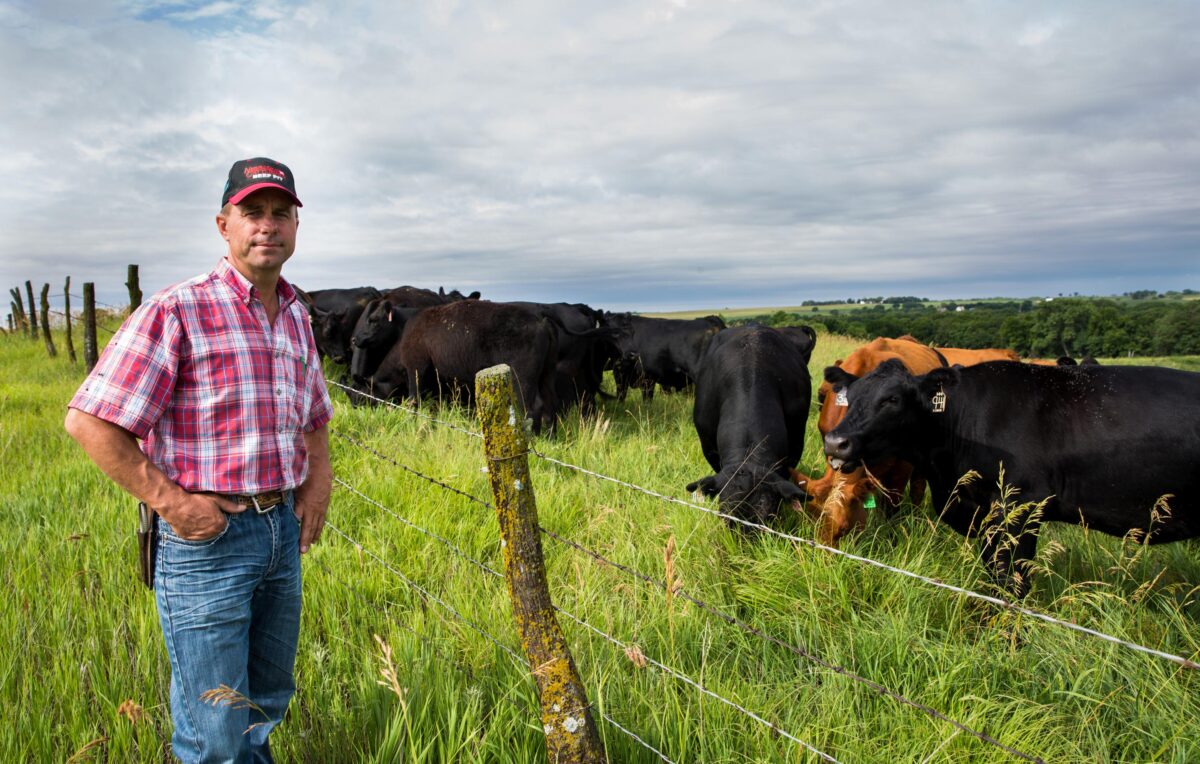
Custom orders have been a lifeline for Rod Christen, a third generation cattle farmer in southeast Nebraska.
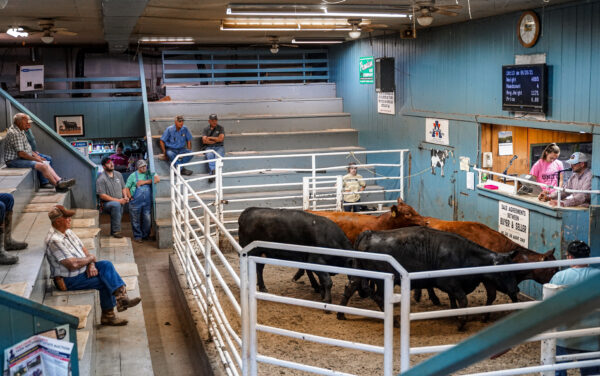
At a local sales barn, he can get about $1.18 for a pound of live calf weight. Through the local lockers he can get up to $1.85. Of some 300 calves he raises a year, about 20 would go directly to customers.
Recently, his business has been on the upswing, aided by online marketing.
“It seems like consumers locally do genuinely care about where their meat comes from and are starting to want to know the producers behind it and want to know how the cattle were raised and some of those things,” he told The Epoch Times.
With beef prices as they are, custom orders have become more attractive for customers economically as well. Christen calculated a consumer price of under $6 for a pound of meat. While certainly a premium for ground beef, it’s a huge discount on the prime cuts.
But there are some disadvantages too.
A whole calf translates to about 500 pounds of beef and another perhaps 200 pounds of fat and bones. That’s a huge delivery for a single customer. Only about 25 pounds are the most desirable rib and T-bone steaks. Another 80 pounds or so are the sirloin, porterhouse, and club steaks. The rest are various roasts and ground meat (pdf).
A common solution has been for several customers, such as an extended family, to band together to buy the animal. Some lockers also accept somewhat smaller orders and wait until they add up to a whole calf.
Christen said another problem is that with the increased demand, lockers have been swamped, resulting in appointments being scheduled a year in advance.
“To predict how many you can sell and to whom you’re going to sell them a year in advance is kind of like throwing darts at the board,” he said.
Yet another problem is that such orders need to be picked up in person by the customer or at best get delivered within a limited radius.
To get around such constraints, Nebraska farmers and other stakeholders have decided to build their own, mid-size packing facility in North Plate, about 70 miles east of the Nebraska-Colorado border.
A major facility would process about 5,000 calves a day. The investors are aiming for about 1,100 a day with completion by 2023.
They set up a company, Sustainable Beef, with a goal of helping local cattle farmers market their beef, especially to customers looking for an extra guarantee of quality and origin. One of their ideas is to use blockchain technology to ensure each cut can be traced to where it came from.
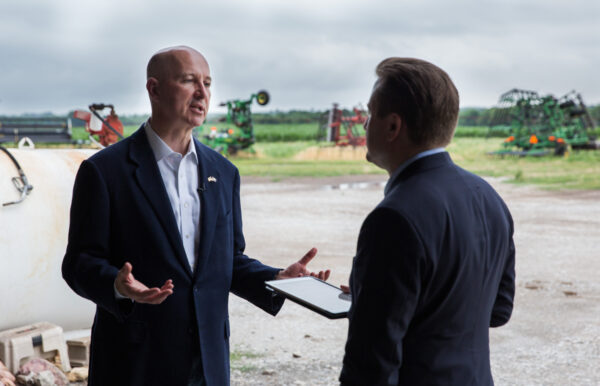
Nebraska Gov. Pete Ricketts supports the plan.
“Additional competition will be needed in the processing industry to make sure the kind of small calf-cow guys and feed lots can have some place to send their cattle and have some leverage,” he told The Epoch Times.
The plant is set to cost close to $300 million. It would employ over 800 people and buy cattle from about a 200-mile radius. Some 30 percent of its output would go to exports.
Guts of the Market
Meatpacking is the thankless industry that takes a 1,000-pound calf, slaughters it, and turns it into hundreds of steaks, roasts, sausages, stew bones, and hamburgers for Americans to boil, broil, and barbecue. For a long time, the industry has been marked by overcapacity, always scrambling to get enough cattle to keep the lines running. Ranchers thrived on the ever-present demand.
Over the past several decades, the industry has consolidated and downsized, resulting in most of the processing falling into the hands of just four companies: JBS, Cargill, National Beef, and Tyson.
In recent years, the packers have been slaughtering about half a million calves a week. They mostly buy from large feedlots that take 700-pound calves from ranches and feed them corn until they reach the optimal weight.
It used to be that feedlots bought most of the cattle through negotiated cash transactions, such as through auctions at local sales barns. Now, they buy about 80 percent through alternative arrangements that price calves based on formulas that include quality criteria and cash prices from the week before.
The alternative marketing is more efficient, saving money for every party involved, including the farmers, according to research by Stephen Koontz, agriculture professor at Colorado State University and expert on beef markets.
But many farmers have complained that there are so few bidders at local sales barns the prices get artificially depressed.
There’s a bipartisan bill in Congress that would mandate at least 30 percent of cattle trade be done in the cash market. Koontz considers that excessive.
He acknowledged that very little trade now occurs at auctions, but said the 20 percent of cattle still sold through negotiated cash transactions is more than enough for effective price discovery.
“Sometimes the right price takes one trade and sometimes it takes a hundred. Of course, more is better but sometimes the marginal value of that second trade is zero—and while more is better, it is also certainly more expensive,” he told The Epoch Times via email.
The question of “how much cash trade is needed” doesn’t have a simple answer, he said.
“Sometimes it’s a lot and sometimes it’s very few. And the evidence is that we can do fine with very, very few transactions.”
He would prefer the industry to set up its own rule-making institutions, similarly to the stock exchange. The industry could, for example, pay some of the large players to act as “market makers” who would be obliged to be always ready to buy or sell cattle, similarly to how stock exchange market makers ensure liquidity.
“More detailed trading institutions are better than a mandatory cash minimum,” Koontz said.
The packers have a natural advantage in the market as they can slow down or speed up their processing lines on relatively short notice. Farmers, on the other hand, need to plan their production years in advance. When the cattle reach their optimal weight, they need to be sold quickly as they lose value if they get too old and fat.
Many farmers suspect the big packers are colluding and using their market influence to depress cattle prices.
“If you get two buyers in the crowd and they sit next to each other and they say, ‘Ok, you can take this load, you take that load,’ well, that’s not competition, you know. They’re taking turns buying. And that’s kind of what’s happening on a larger scale with major packers. It’s the way we see it anyway,” Christen said.
About a dozen state attorney generals requested a Department of Justice investigation into the matter last year. President Donald Trump backed the request and the investigation is still underway. In May, six governors, including Ricketts, urged for the investigation to continue.
None of the big four meatpacking companies responded to requests for comment.
Tim Zook became ill 2-and-a-half hours after his second dose of Pfizer’s vaccine, and died four days later. An autopsy showed an enlarged heart — consistent with myocarditis now linked to mRNA COVID vaccines — but the coroner ruled out the vaccine as cause of death.
A healthcare worker who died four days after his second dose of Pfizer’s COVID vaccine was killed by heart disease, according to the Orange County, California coroner.
Tim Zook, an x-ray technologist at South Coast Global Medical Center in Santa Ana, was hospitalized Jan. 5 — just hours after being vaccinated. Zook’s wife, Rochelle Zook, told the Orange County Register her husband’s health rapidly deteriorated after receiving his second dose of Pfizer’s vaccine. Tim Zook died Jan. 9.
The wife of Tim Zook, a 60-year-old x-ray technician who became seriously ill hours after getting his second #Pfizer#vaccine and died four days later, says “we need to know the cause.” #TheDefenderhttps://t.co/B8VCMRVTeY
An autopsy report released Wednesday found Tim Zook’s heart was severely enlarged, thicker than normal and dilated. “There is a focus of severe coronary artery disease,” according to the report, which also said Tim Zook’s heart valves showed mild-to-moderate calcium deposits.
The autopsy report concluded the official cause of death was “hypertensive and atherosclerotic heart disease with severe cardiomegaly [enlarged heart] and heart failure.”
There was no mention of inflammation in Tim Zook’s autopsy report, and no mention of vaccination playing a role in his death.
Still, Rochelle Zook, Tim’s widow, is not convinced her husband’s death is unrelated to the vaccine.
“Heart enlargement? How did his heart get enlarged?” Rochelle Zook said. “He had been seeing a doctor and getting checkups and tests — no one mentioned an enlarged heart.”
Tim Zook was “quite healthy,” his wife said shortly after her husband’s death, though he took medication for high blood pressure and was slightly overweight. “He had never been hospitalized. He’d get a cold and be over it two days later. The flu, and be over it three days later.”
Rochelle Zook’s theory is that vaccines are so new that much remains unknown — though she and her three adult sons have all taken the vaccine.
She preserved samples of her husband’s tissue for future testing, hoping to learn more as data about vaccines emerge in years to come.
“We closely monitor all such events and collect relevant information to share with global regulatory authorities. Based on ongoing safety reviews performed by Pfizer, BioNTech and health authorities, (the vaccine) retains a positive benefit-risk profile for the prevention of COVID-19 infections. Serious adverse events, including deaths that are unrelated to the vaccine, are unfortunately likely to occur at a similar rate as they would in the general population.”
“No prescription drug or biological product, such as a vaccine, is completely free from side effects,” states the CDC in its primer for the Vaccine Adverse Event Reporting System (VAERS), where Tim Zook’s death was logged and where anyone can report reactions. “Vaccines protect many people from dangerous illnesses, but vaccines, like drugs, can cause side effects, a small percentage of which may be serious.”
According to the latest data, between Dec. 14, 2020 and July 2, 2021, there have been 9,048 deaths following COVID vaccines reported to VAERS. Of those, 22% occurred within 48 hours of vaccination, 15% occurred within 24 hours and 37% occurred in people who became ill within 48 hours of being vaccinated.
The chairwoman of the Congressional Black Caucus celebrated her arrest Thursday after leading an incursion of protesters into the Hart Senate Office Building on Capitol Hill.
Democratic Rep. Joyce Beatty of Ohio said that breaking the law was an important way to illustrate her belief that voting reforms passed by state legislatures will disenfranchise black voters.
“I stand in solidarity with Black women and allies across the country in defense of our constitutional right to vote. We have come too far and fought too hard to see everything systematically dismantled and restricted by those who wish to silence us,” Beatty said in a statement on her website.
“You can arrest me. You can’t stop me. You can’t silence me,” Beatty said on Twitter.
You can arrest me. You can’t stop me. You can’t silence me.
NBC News reported that the protesters who joined Beatty in the incursion demanded passage of the so-called For the People Act, a Democrat bill that would largely put elections under the thumb of the federal government instead of the states.
Capitol Police said the demonstrators were arrested after refusing to disperse.
“This afternoon, nine people were arrested for demonstrating in a prohibited area on Capitol Grounds,” the department said in a statement on Thursday.
“At approximately 3:30pm, the United States Capitol Police responded to the Atrium in the Hart Senate Office Building for reports of illegal demonstration activity. After officers arrived on the scene, they warned the demonstrators three times to stop. Those who refused were arrested for D.C. Code §22-1307. Two males and seven females were transported to USCP Headquarters for processing,” Capitol Police said.
Unlike the coverage of the Jan. 6 incursion of the U.S. Capitol by supporters of then-President Donald Trump, there was no hue-and-cry in the media about Beatty and the other protesters staging an “insurrection” or “threatening our democracy.”
Police arrested nine people including Democratic Congresswoman Joyce Beatty, who chairs the Congressional Black Caucus, in a prohibited area on Capitol Grounds during a pro-voting rights demonstration pic.twitter.com/kWZjpJrwYz
Many Republicans have said the fight over election reform legislation is an attempt by Democrats to use their current congressional majority as a means to cement leftist rule in America.
Missouri Sen. Josh Hawley warned Thursday that big tech is “acting like arms of the government” after the White House admitted that it is asking Facebook to comply with censoring anyone who posts content it deems to be “misinformation”.
Here’s the backstory:
🚨🚨: Jen Psaki says the Biden administration is actively flagging what they deem "disinformation" about the pandemic to Facebook for censoring.
Tucker Carlson discusses the Biden admin teaming up with Facebook to censor “misinformation.” pic.twitter.com/XLyKjgqyTd
— The Post Millennial (@TPostMillennial) July 16, 2021
If you don't find it deeply disturbing that the White House is "flagging" internet content that they deem "problematic" to their Facebook allies for removal, then you are definitionally an authoritarian. No other information is needed about you to know that.
Appearing on Fox News, Hawley warned “I think it’s really scary to have the federal government of the United States, the White House compiling lists of people, organizations, whatever and going to a private company that by the way is a monopoly – Facebook – and saying you need to censor.”
“I just think that this kind of coordination between big government and the big monopoly corporation, boy that is scary stuff,” Hawley said, adding “It really is censorship.”
(Christian Today) The Billy Graham Evangelistic Association is to receive £109,000 from Blackpool Council over cancelled adverts for an evangelistic event featuring its CEO, Franklin Graham.
Adverts for the 2018 Lancashire Festival of Hope ran on local buses but were removed because of Graham’s traditional views on marriage. It followed a social media campaign by local LGBT activists.
But the council has admitted it was in the wrong and agreed to pay the festival’s legal costs, totalling £84,000, and another £25,000 in damages.
The settlement was reached after an April ruling from Manchester County Court that, in removing the ads, Blackpool Council and Blackpool Transport Services violated the Equality Act and the Human Rights Act.
After reaching the settlement, Cllr Lynn Williams, Leader of Blackpool Council, issued an apology in which she said lessons had been learned.
“We accept that the advertisements were not in themselves offensive. We further accept that in removing the advertisements we did not take into account the fact that this might cause offence to other members of the public and suggest that some voices should not be heard. We also regret that we did not consult with the organisers prior to taking our decision,” she said.
“We accept the findings of the court that we discriminated against Lancashire Festival of Hope because of the religious beliefs of Franklin Graham and in doing so interfered with Lancashire Festival of Hope’s right to freedom of speech.
“We sincerely apologise to the organisers of the event for the upset and inconvenience caused.
“We have learnt from this experience. We are committed to ensuring equality of access and opportunity for the population of Blackpool and providing and improving quality services for all. We have now introduced clear and transparent policies that will ensure no repeat of events such as these.”