

Home Blog Page 3467

Tucker: Democrats are doing everything they can to stay in power

Weekly Update — Afghanistan: A Tragically Stupid War Comes to a Tragic End

Father of Fallen Marine in Kabul Reveal Shocking New Details from Biden Watch Check Scandal

The Afghanistan Crisis is Worse Than You Think

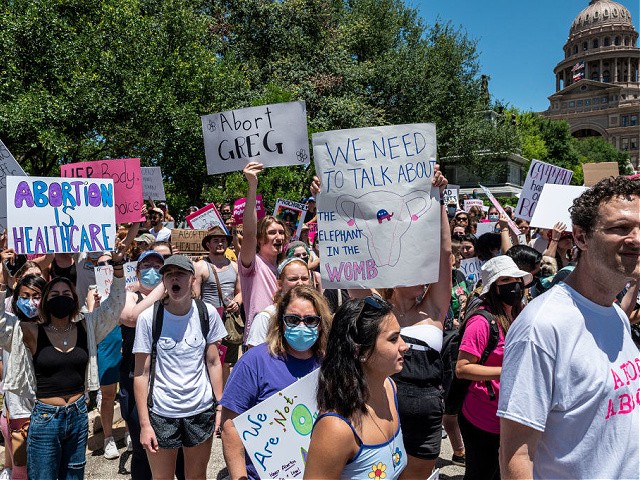
SCOTUS Lets Texas Six Week Abortion Ban Stand

In a pro-life victory, the Supreme Court of the United States ruled 5-4 on Wednesday not to block the new Texas law banning most abortions after six weeks of pregnancy while legal challenges to that law proceed in lower courts.

A narrow majority of justices held that the abortion-provider plaintiffs had failed to meet the high standard required for the Supreme Court to issue an injunction blocking a law before it goes into effect.

Signed in May by Texas Gov. Greg Abbott (R), Senate Bill 8 effectively bans abortions in the Lone Star State the moment a fetal heartbeat is detected, which often occurs after six weeks of pregnancy. Since women do not often detect pregnancy prior to the sixth week, the law effectively bans abortions in the state. Multiple states have tried to implement similar measures only to be blocked by the courts.

The five-justice majority of Justices Clarence Thomas and Samuel Alito, and Trump-appointed Justices Neil Gorsuch, Brett Kavanaugh, and Amy Coney Barrett did not issue a published opinion with their decision, so the precise reasoning of the Court remains unclear, including whether the Texas law would survive a constitutional challenge on the merits when that question is squarely before the Supreme Court.

“The applicants now before us have raised serious questions regarding the constitutionality of the Texas law at issue,” Chief Justice John Roberts wrote in dissent. “But their application also presents complex and novel antecedent procedural questions on which they have not carried their burden.”

Roberts explained that he was dissenting because an injunction would freeze the status quo while the courts work through whether Texas’s law violates a constitutional right to abortion, narrowly leaving open the possibility that he could vote in favor of the law down the road.

The three liberal justices, Stephen Breyer, Sonia Sotomayor, and Elena Kagan issued strongly worded dissents against the Lone Star State’s law.

Legal proceedings in the lower courts might not move forward until a citizen attempts to enforce it against an abortion provider, leaving the pro-life measure in effect indefinitely. The Supreme Court will also hear a major abortion case this term, Dobbs v. Jackson Women’s Health, and it’s possible that this case and other abortion cases will be held in abeyance until the Supreme Court renders a decision in that case.

The case is Whole Woman’s Health v. Jackson, No. 21A24 in the Supreme Court of the United States.

Marist Poll: Biden Approval Tanking in Wake of Afghan Withdrawal Chaos

President Joe Biden’s approval rating is sinking in the wake of the chaotic and deadly Afghanistan pullout, a new poll showed Thursday.

The Marist poll found Biden’s approval slid to 43% — down 6 percentage points from a July survey and the lowest mark for Biden since he took office, NPR reported.

The news outlet said the drop was fueled largely by independents; just 36% approve of the job Biden’s doing, a 10-point drop; 85% of Democrats approve, a 5-point drop, and 5% of Republicans approve, a 1-point dip.

The poll found 41% of adults strongly disapprove of the job Biden’s doing, similar to the number who disapproved of former President Donald Trump.

In a breakdown, the poll also found:

  • 61% disapprove of Biden’s handling of the Afghan withdrawal.
  • 71% think the war in Afghanistan was a failure, with 38% believing the United States should have withdrawn but left some troops, 37% thinking it should have been a complete pullout, and 10% saying no troops should be withdrawn.
  • 29% of respondents think the U.S. has a duty to continue its involvement in Afghanistan; 61% think it needs to be up to Afghans to determine their future without U.S. involvement.
  • 73% say they support allowing refugees to come to the United States, with 49% of Republicans approving of refugees coming to the United States, while 44% do not.
  • 44% think the nation is less safe than it was before 9/11 — including two-thirds of Republicans; 30% say it’s safer and 25% say it’s about the same.

The telephone survey’s margin of error of the full sample was plus or minus 3.9 percentage points.

The approval slide comes just days after a Morning Consult poll that found Biden’s approval rating sank to 48% in the wake of the withdrawal from Afghanistan.

A graph from the polling indicates that this is the first time in Biden’s presidency when more voters disapprove, at 49%, than approve of him, at 48%, due in part, to the Afghan withdrawal, that survey showed.

WHO Issues Guidance On Digital COVID Certificates Called ‘Conspiracy Theory’ By Media.

A newly published World Health Organization (WHO) report urges the transition to digital certification of vaccine status, presenting implementation strategies for member states.

The report is labeled as “interim guidance” which should serve countries help in their fight against COVID-19 and “to capture vaccination status to protect against other diseases”.

The central premise appears to be the implementation of Digital Documentation of COVID-19 Certificates (DDCC) which will act as an agent to present and review vaccination status, history of SARS CoV-2 infection and test results. The report acts as a technical guidance, in regard to infrastructure, digital verification processes, and “ethical standards”.

The executive summary states:

In the context of the coronavirus disease (COVID-19) pandemic, the concept of Digital Documentation of COVID-19 Certificates (DDCC) is proposed as a mechanism by which a person’s COVID-19-related health data can be digitally documented via an electronic certificate A digital vaccination certificate that documents a person’s current vaccination status to protect against COVID-19 can then be used for continuity of care or as proof of vaccination for purposes other than health care. The resulting artefact of this approach is referred to as the Digital Documentation of COVID-19 Certificates: Vaccination Status (DDCC:VS).

The main uses of DDCC – as reflected in the report – are:

  1. Continuity of care – record of vaccination – to inform individuals and health care workers when and what type of vaccine should a person receive (in the future).
  2. Proof of Vaccination – vaccination status for purposes not related to health care, such as University education, travel, survey participation.

The report also describes how vaccination should lead to different steps of verification and database administration, after the person receives the vaccination. The certification would transition through security verification steps until a digital certification is generated. Despite the detailed description of various verification steps, the report never signifies the reason why digital verification is needed and why nation states should follow the process to implement a whole new infrastructure. The only stated downside of paper-based verification is potential fraud.

Proof of Vaccination.

Furthermore, the report signifies scenarios where people have “to prove their COVID-19 vaccination status (such as care site, a school, or an airport).”, despite this policy being implemented in only a few places such as New YorkFrance, and Italy.

Data sets & Structures.

The report states that bare minimum information should be included in the identification process. However, the WHO also lists mandatory, new data points that need to be linked to the vaccination status:

  • Name;
  • Date of Birth;
  • Unique Identifier (National ID, Health ID etc.);
  • Sex;
  • Vaccine type;
  • brand;
  • manufacturer;
  • market authorization holder;
  • batch number;
  • date of vaccination;
  • Vaccination valid from;
  • dose number;
  • total doses;
  • country of vaccination;
  • administering center;
  • signature of health worker;
  • health worker ID;
  • disease targeted (name of the disease that vaccine given to protect again);
  • Due date of next dose;
  • certificate issuer;
  • health certificate ID;
  • certificate valid from;
  • certificate valid until;
  • certificate schema version.

Implementation.

The certification would “help” member states either as short-term solution or long-term. In the case of short-term solution, the report suggests the usage of certification until COVID-19 is no longer considered a public health emergency.

Member states, however, can also keep the system to address other pandemics and “to build digital health infrastructure that can be a foundation for digital vaccination certificates beyond COVID-19…”

The report id funded by the Bill and Melinda Gates Foundation, the Government of Estonia, Fondation Botnar, the State of Kuwait, and the Rockefeller Foundation.

Podcasting app Callin raises $12 million in Series A funding

Callin, a San Francisco-based social podcasting app, raised $12 million in Series A funding co-led by Sequoia Capital, Goldcrest Capital and Craft Ventures (which incubated the company).

Why it matters: This could be the holy grail of podcast production; a single software stack for recording, editing, transcription and distribution. Plus an added twist of live audience participation (i.e., Clubhouse, but with a long tail). Key will be achieving high quality audio, which can be hard to do via mobile apps (just ask Anchor FM, now owned by Spotify).

Listen up: Last night Axios interviewed David Sacks of Craft Ventures, who co-founded Callin and is serving as its executive chairman. The conversation will be available soon on the app, which this morning came out of beta (update: here it is).

The bottom line, via Axios’ Sara Fischer: “In the end, standalone podcast apps almost always get bought by bigger music subscription apps as added value.”

Our Defeat In Afghanistan Is Only The Beginning

As the post-9/11 chapter closes, a new one begins, marked above all by the end of American deterrence and the eclipse of American power.

Our total defeat and ignominious, disastrous withdrawal in Afghanistan, after 20 years of war and nation-building, closes a chapter on post-9/11 America — and opens another.

What comes next is to some extent uncertain, but you don’t need to be a grand strategist to see the broad outlines of what is already taking shape.

First and most obvious, Afghanistan will revert to being a terrorist haven. The Islamic Emirate of Afghanistan, by its very nature, will not keep to itself, the erstwhile assurances of Taliban officials notwithstanding. Every committed jihadist on earth who can get to Afghanistan is headed that way now or making plans to do so.

Our military leaders have already admitted as much. Two weeks ago, well before the suicide bombing attacks that took the lives of 13 American soldiers and scores of Afghans, the Pentagon told U.S. senators that the collapse of the Afghan government and the Taliban takeover means terrorist groups will reconstitute in Afghanistan more quickly than was previously estimated.

On an August 15 phone call with top Biden officials and senators from both parties, Chairman of the Joint Chiefs of Staff Mark Milley said the previous assessment, back in June, was that there was a “medium” risk that terrorist groups would form in Afghanistan within two years of the U.S. withdrawal. Asked if he believed that timeline would have to be moved up in light of recent events, Milley reportedly responded, “Yes.”

In practical terms, this means in the years to come we’re almost certainly going to see a resurgence of Islamist terrorism worldwide, and likely another attack on American soil. Why? Because for al-Qaeda, and for jihadists the world over, the Taliban’s victory in Afghanistan is a vindication of 9/11, a strategic victory. After 20 hard years, they won and we lost.

Osama bin Laden predicted something like this would happen. Not long after the U.S. invasion of Afghanistan, bin Laden issued a “letter to the American people,” in which he declared that, like the Soviet invasion of an earlier generation, the Americans would eventually leave in defeat:

If the Americans refuse to listen to our advice and the goodness, guidance and righteousness that we call them to, then be aware that you will lose this Crusade Bush began, just like the other previous Crusades in which you were humiliated by the hands of the Mujahideen, fleeing to your home in great silence and disgrace. If the Americans do not respond, then their fate will be that of the Soviets who fled from Afghanistan to deal with their military defeat, political breakup, ideological downfall, and economic bankruptcy.

Bin Laden and those who planned 9/11 recognized the U.S. invasion of Afghanistan for the strategic error it has proven to be. All of them understood the collapse of the Soviet Union as a direct consequence of the USSR’s failed invasion and occupation of Afghanistan, and credited the mujahadeen with the collapse of the communist superpower. It might take time, they thought, but the same would happen to the United States should it be foolish and arrogant enough to invade and occupy the country. And we were.

For all that, a Soviet-style collapse of the U.S. won’t happen. But our humiliation in Afghanistan will have global reverberations. The military power of the United States was the last institution of public life Americans really trusted, and it was the foundation of other nations’ trust in us — or fear of us.

Our adversaries will react accordingly. China, above all, will understand our defeat in Afghanistan as the end of American deterrence and a chance to press its irredentist agenda in Taiwan and the South China Sea. Moscow and Tehran will come to similar conclusions, as will Pyongyang.

Indeed, over the weekend, the Wall Street Journal reported that North Korea has resumed operation of its plutonium-producing reactor at Yongbyon, which had been inactive since December 2018. The operation of the reactor has apparently coincided with signs that North Korea has also begun to separate plutonium from spent fuel previously removed from the reactor.

For our allies, the end of American deterrence will likely prompt a strategic recalibration. Why would Taiwan, which this week issued a dire warning that China’s armed forces could “paralyze” Taiwan’s defenses, put its faith in an alliance with the United States? Why would Ukraine or Poland?

As we learn more in the coming weeks and months about the fecklessness and deceit of the Biden administration’s Afghanistan withdrawal — including Biden’s appalling conversation with then-President Ashraf Ghani, urging him to “project a different picture” of the fight against the Taliban, “whether it is true or not” — every nation in the world will take note of what our promises are worth.

Some of these developments will take decades to mature, but others will move rapidly. By the end of Biden’s term, assuming he’s able to see it through, we might well long for the days when all we had to worry about was our humiliation in Afghanistan. We’ll certainly come to see the events of the past few weeks in a stark new light: as the beginning of a dark chapter in world history, marked above all by the eclipse of American power and influence in an increasingly dangerous world.