State legislative special elections provide an interesting index of partisan sentiment these days. That wasn’t so in the late 20th century, when clever candidates and local notables often got voters to cross party lines. But in this century of increasing partisan polarization and straight-ticket voting, local special elections are a proxy for opinions on national issues.
In that light, consider the results of the two special legislative elections that have resulted in a change of parties so far this year.
The first was in Connecticut’s 36th Senate District on Aug. 17. This is the richest state Senate district in Connecticut and may be the richest in all of America. It includes the super-rich town of Greenwich, where Prescott Bush, the father and grandfather of presidents, served as moderator of the Representative Town Meeting for 17 years, plus nearly as rich New Canaan and the northern half of Stamford.
The 36th District is ancestral Republican country that trended Democratic during the Trump presidency. Republican Scott Frantz won it by 60% to 39% in 2016, then lost 50% to 49% to Democratic candidate Alex Kasser in 2018, who held it 51% to 49% over Republican Ryan Fazio in 2020. Not atypical results for a seat packed with affluent college graduates.
But in 2021, Kasser resigned, and Fazio regained the seat by a bare 2-point margin. Republicans hailed this as a big victory, but it was more a sign that, after eight months of President Joe Biden, high-income disgust with former President Donald Trump had crested.
The other party flip happened this month in the demographically dissimilar Iowa 29th House District, which includes most of Jasper County and industrial Newton, the longtime home of Maytag. It’s an area with many blue-collar workers and union members and was long a safe Democratic district. Democrat Wesley Breckenridge won it twice by double digits — 51% to 38% in 2016 and 59% to 41% in 2018. But then he won by only 52% to 48% in 2020. After he resigned in 2021, Republican Jon Dunwell won on Oct. 12 by a 20-point margin.
Trump lost in 2020 because he fell behind his 2016 showing among upscale voters and failed to make up the difference among downscale white and minority voters. The Greenwich and Newton legislative results suggest that Republicans have staunched the bloodletting among the affluent and have regained momentum with downscale voters.
This is in line with CNN analyst Harry Enten’s observation that since April 2021, Republicans have been running well ahead of their November 2020 levels. It’s consistent with the widespread sense that Democrats are likely to lose, and may lose a lot of, the narrow 222-213 House majority they won in 2020.
The wild card in this is, as always in years ending in “2,” redistricting. Democrats control redistricting in relatively few states, but they seem bent on aggressively eliminating the few Republican seats in Illinois and New York, and they are even targeting the single Republican seats in Maryland and New Mexico.
Note the deafening silence of the liberals who have been lamenting that Republican redistricting threatens the end of democracy. Similarly, liberals were nonplussed by gerrymandering when Democrats controlled most redistricting in the 1962, 1972, and 1982 cycles. Sauce for the goose but not for the gander.
But as the Cook Political Report’sDavid Wasserman points out, redistricters can be incompetent or too clever by half. If you create a bunch of 52% districts for your party, you’re liable to lose all of them when your party’s numbers go down a few points.
Over the long run, it’s probably smarter to shore up your incumbents, as Texas Republicans are doing, and to concede the other side some seats where the tide has been going their way. In the 1980s, the affluent north Dallas and west Houston districts were the most Republican in the country. But they flipped Democratic in 2018, and now Republicans are making them more Democratic for 2022.
One more note on redistricting. The supposedly nonpartisan redistricting commissions enacted in some states and lavishly praised by liberal commentators aren’t working out so well. Inevitably, they’ve become partisan slugfests, for who other than partisans would want to spend their time drawing district lines on maps? Political science professors? They’re 95% Democrats. Think tankers? All committed to one side or the other. Journalists? You’ve got to be kidding.
The plain though perhaps unpalatable fact is that there always will be politics in politics, especially in times of close partisan competition — even, or especially, in special elections to state legislatures.
(The Verge) Mark Zuckerberg wants to be known for building the metaverse
Facebook is planning to change its company name next week to reflect its focus on building the metaverse, according to a source with direct knowledge of the matter.
The coming name change, which CEO Mark Zuckerberg plans to talk about at the company’s annual Connect conference on October 28th, but could unveil sooner, is meant to signal the tech giant’s ambition to be known for more than social media and all the ills that entail. The rebrand would likely position the blue Facebook app as one of many products under a parent company overseeing groups like Instagram, WhatsApp, Oculus, and more. A spokesperson for Facebook declined to comment for this story.
Facebook already has more than 10,000 employees building consumer hardware like AR glasses that Zuckerberg believes will eventually be as ubiquitous as smartphones. In July, he told The Verge that, over the next several years, “we will effectively transition from people seeing us as primarily being a social media company to being a metaverse company.”
A rebrand could also serve to further separate the futuristic work Zuckerberg is focused on from the intense scrutiny Facebook is currently under for the way its social platform operates today. A former employee turned whistleblower, Frances Haugen, recently leaked a trove of damning internal documents to The Wall Street Journal andtestified about them before Congress. Antitrust regulators in the US and elsewhere are trying to break the company up, and public trust in how Facebook does business is falling.
Facebook isn’t the first well-known tech company to change its company name as its ambitions expand. In 2015, Google reorganized entirely under a holding company called Alphabet, partly to signal that it was no longer just a search engine, but a sprawling conglomerate with companies making driverless cars and health tech. And Snapchat rebranded to Snap Inc. in 2016, the same year it started calling itself a “camera company” and debuted its first pair of Spectacles camera glasses.
I’m told that the new Facebook company name is a closely-guarded secret within its walls and not known widely, even among its full senior leadership. A possible name could have something to do with Horizon, the name of the still-unreleased VR version of Facebook-meets-Roblox that the company has been developing for the past few years. The name of that app was recently tweaked to Horizon Worlds shortly after Facebook demoed a version for workplace collaboration called Horizon Workrooms.
Aside from Zuckerberg’s comments, Facebook has been steadily laying the groundwork for a greater focus on the next generation of technology. This past summer it set up a dedicated metaverse team. More recently, it announced that the head of AR and VR, Andrew Bosworth, will be promoted to chief technology officer. And just a couple of days ago Facebook announced plans to hire 10,000 more employees to work on the metaverse in Europe.
The metaverse is “going to be a big focus, and I think that this is just going to be a big part of the next chapter for the way that the internet evolves after the mobile internet,” Zuckerberg told The Verge’s Casey Newtonthis summer. “And I think it’s going to be the next big chapter for our company too, really doubling down in this area.”
Complicating matters is that, while Facebook has been heavily promoting the idea of the metaverse in recent weeks, it’s still not a concept that’s widely understood. The term was coined originally by sci-fi novelist Neal Stephenson to describe a virtual world people escape to from a dystopian, real world. Now it’s being adopted by one of the world’s largest and most controversial companies — and it’ll have to explain why its own virtual world is worth diving into.
Several months ago, we expressed at least “theoretical reservations” about vaccinating cancer patients or former patients who had been cured, because of the underlying mechanism of the gene injection on immunity.
Several geneticists had also expressed their concerns about the possible interference between active or dormant cancer cells and the activity of gene therapy on lymphocytes in particular.
Months have passed, and the vaccine madness has amplified, leading to the refusal of patients without a passport in hospitals (which, as is well known, are intended to receive only healthy people) and to the demand that patients be vaccinated before receiving any treatment, including cancer patients.
We are in a world gone mad and yet these stories are multiplying, such as this young man of 22 years who had a chronic cough leading to an X-ray discovering a mediastinal mass. The two big Paris hospitals that received him refused to start the treatment (without it being explained in detail) if the patient refused the experimental injection, of absolutely unknown effects on the development of cancers.
The doctors’ justification? None: “that’s the way it is”, and we have accepted it!
Silence on the colleagues suspended for lack of obedience and even more on the objective reasons that made them prefer to lose their jobs, their remuneration, their houses, their families intolerant to these decisions as well, rather than submit to the presidential ukase to accept experimental drugs…
Would more than three hundred thousand caregivers (a figure that is probably highly underestimated given the number of hospitals and clinics currently forced to close beds and postpone interventions due to lack of personnel) be crazy, conspiratorial or delusional to the point of putting themselves in great personal, social, family, professional and psychological danger?
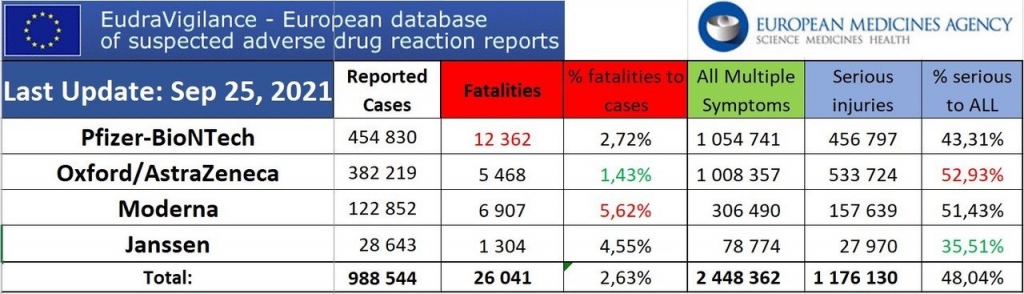
Have the doctors who claim that vaccination is safe taken the time to look at the statistics of the effects reported and accepted by the official agencies? Are the FDA, EMA, MHRA also “conspiratorial” when they release statistics as in the case of VAERS, which is entity of the CDC:
VAERS as of September 26, 2021
More than 726,000 Covid vaccine-related adverse events reported to VAERS as CDC and FDA overturn advisory committee recommendations on Pfizer’s third vaccine.
VAERS data released by the CDC included a total of 726,965 adverse event reports from all age groups following Covid vaccines, including 15,386 deaths and 99,410 serious complications between December 14, 2020, and September 17, 2021.[1]
Or Eudra Vigilance pharmacovigilance body of the European Medicines Agency
Or even the ANSM, our French agency, which shows more than 1200 deaths accepted as at least possibly related to these experimental injections.
All therapeutic trials for fifty years were stopped after a few deaths for investigation (53 deaths stopped the H1N1 vaccine). Here, thousands of deaths throughout the world and children are shamelessly attacked[2]. How can we continue to believe that this is a health policy?
Why this denial of the most solid sects on the part of theoretically educated doctors, capable of obtaining information directly from reliable sources and equipped with a brain?
Fear of the boss, of the director, who in a few months’ time will inevitably be called into question, since many countries are backtracking and even Germany wants to get out of vaccine terrorism, perhaps on the occasion of Mrs Merkel’s departure[3].
“The leading organizations of contracted physicians in Germany are demanding an immediate end to the “anti-corona” measures and an end to the “horror rhetoric and panic politics”. Obviously, French hospital doctors in Paris and elsewhere do not read German newspapers and are terrorized by the threats of their professional association, their minister, and become kapos[4] and terrorize their patients.
More and More Testimonies are Coming In
Whatever their unacceptable reasons, testimonies are multiplying.
A young girl accompanies her friend to her mother’s funeral… such a mother, mother of a high school friend, 34 years old, in remission from breast cancer for two years, who is injected with the vaccine and collapses a few days later in a coma and dies after three days of hospitalization… Politically correct explanation: the cancer exploded and took her away. Close the chapter and the coffin.
What would Maigret have said? [Historic Police Investigator]
But too many coincidences shock the police investigators in front of a corpse. Only doctors would not have the right to think about coincidences of time, for example: “temporality” is their key word…
Like the misleading slogan, “the numbers are always right”. Yes, if they are true and observed in the real world.
But how much confidence can we have in the rigged simulations that the government and the media feed us without ever specifying that they are only predictions or estimates? 5] But one can do what one wants with the figures, when one chooses them, or creates them to justify the chosen hypothesis, and the the results are totally blurred.
In any case, as far as “cancer and gene injection” is concerned, the vagueness unfortunately dissipates in front of the multitude of terrible stories.
From the colleague who sees multiple “balls” appearing under her armpits, which the check-ups in the hospital do not explain… Obviously no possible link with the vax. And yet the ganglions that appear some time after the injection are a frequent observation after these vax.
So clearly there seems to be three situations:
The appearance of a cancer rapidly after the injection (two weeks to a few months) and very progressive, in a person who was previously free of known carcinological pathologies.
The resumption of cancer in a patient who has been in complete remission for several months or years.
The rapid, even explosive, evolution of a cancer that is not yet controlled.
Beyond the testimonies that are pouring in from relatives and friends and on social networks, a Swiss newspaper has finally addressed the subject in a broader way.
Here are some excerpts from their article[6] and their references[7]:
“Can covid vaccines cause cancer?
In some cases, the answer seems to be yes. Certainly, there is no evidence that the covid vaccines themselves are carcinogenic. However, it has been shown that in up to 50% of vaccinees, covid vaccines can induce temporary immunosuppression or immune dysregulation (lymphocytopenia) that can last for about a week or possibly longer.
Furthermore, covid mRNA vaccines have been shown to “reprogram” (i.e., influence) adaptive and innate immune responses and, in particular, to downregulate the so-called TLR4 pathway, which is known to play an important role in the immune response to infections and cancer cells.”
Thus the authors conclude that it is quite possible that these immune changes could have unintended consequences on the condition of the recipient of the gene injection. A matter of common sense indeed!
“Thus, if there is already a tumor somewhere – known or unknown – or if there is a predisposition to a certain type of cancer, such a state of vaccine-induced immune suppression or immune dysregulation could potentially trigger sudden tumor growth and cancer within weeks of vaccination. It should be noted that lymphocytopenia was also frequently observed in cases of severe covid.
Post-vaccination reactivation of latent viral infections, including shingles virus, EBV (Epstein-Barr) and hepatitis virus, has also been observed.
“Vaccine-induced temporary immunosuppression is also a factor that may contribute to the post-vaccination spike in coronavirus infections seen in many countries.”
Frequency of Vaccine Related Adverse Event in Cancer
There are already a few thousand observations in official adverse event reporting and online patient groups. There are certainly true coincidences or diagnostic delays due to delayed diagnosis related to containment. But we should not dismiss the huge problems that these real people affected in their daily lives and even more the responsibility that cancer doctors take by imposing the injection before any treatment or protocol continuation. Their main argument: “we did it right, without discussion” does not seem worthy of a once thoughtful profession.
In August 2021, Dr. Ryan Cole,[8] an American pathologist for many years, described a significant increase in certain types of cancer (e.g. endometrial cancer, uterine cancer) since the beginning of the covid mass vaccination campaign. More recently, German pathologists have also noted the problem of post-vaccination immune dysregulation and sudden tumor growth in some patients.
On the French networks, several testimonies coincide with the reappearance of vaginal hemorrhages in women over 85 years of age leading to the diagnosis of endometrial cancer and rapid death… The spike protein produced by the body following the injection is particularly attracted to the genitals, and this would be a new demonstration of this.
So until we know more, let’s be careful, both doctors and caregivers, and not play the sorcerer’s apprentice!
Caution is required with all experimental treatments and even more so when they are the result of a technique never used before in infectious pathology. First, do no harm must guide the decisions of any physician faithful to his Hippocratic oath.
The far-left “Squad” of progressive lawmakers spent nearly $100,000 on private security in the third financial quarter — despite their incessant calls to “Defund the Police.”
Reps. Ilhan Omar, Alexandria Ocasio-Cortez, Cori Bush and Ayanna Pressley collectively amassed a huge amount of private security bills.
“Ocasio-Cortez’s campaign spent over $10,000 on private policing with Cest Bond Collective, Three Bridges NY LLC and Tullis World Wide Protection, eclipsing Rep. Ayanna Pressley’s, D-Mass., personal security bill of almost $4,000 with Ware Security Consultants Inc., FEC records show,” Fox News reports. “Both Ocasio-Cortez and Pressley are dwarfed in their security spending, though, by Reps. Ilhan Omar, D-Minn., and Cori Bush, D-Mo.”
The report continued on to say that “Omar’s FEC records revealed the defund law enforcement advocate has spent over $22,000 on private security with Aegis Logistics LLC and Lloyd Security Services while Bush took the cake by throwing down another $65,000 on private security.”
“Bush’s campaign spent $64,141.26 on private security between the beginning of July and late September, the Federal Election Commission records show. The cash was dished out to a handful of firms, including Peace Security, RS&T Security Consulting, Aegis Logistics, Whole Armor Executive Protection & Security and Nathaniel Davis, whose payments are sent to the same address as her campaign headquarters.”
Each of these women have been outspoken about taking away pol
In-N-Out Burger is rebelling against the “clear overreach” of San Francisco’s COVID-19 mandates by insisting “we refuse to be the vaccination police.”
Based.
The restaurant was raided by public health officials on September 24 and then again on October 6, with inspectors telling staff “multiple times” that they needed to check the vaccination status of customers.
The branch, the only In-N-Out Burger in San Francisco, was shut down on October 14 before being reopened but only for outdoor service.
After noting that it had displayed “signage” informing people of the rules, the restaurant insisted that it would not “segregate customers into those who may be served and those why may not, whether based on the documentation they carry, or any other reason.”
The fast food chain’s chief legal and business officer Arnie Wensinger then made the company’s stance even clearer, asserting, “We refuse to become the vaccination police for any government.”
Wensinger added that the mandate was an example of “clear governmental overreach,” describing it as “intrusive, improper, and offensive.”
Leftist groups immediately reacted with fury.
BREAKING: In-N-Out burger restaurant in San Francisco attacks the city's vaccine mandate, saying they refuse to be "the vaccination police for any government" after being temporarily shut down for COVID violations. RT IF YOU THINK THEIR BEHAVIOR IS SHAMEFUL!
It’s a mystery as to why leftists are mad, after all they repeatedly tell us that private companies can ‘do what they like’ when it comes to their relationships with customers.
Meanwhile, “More than 180 city officials, including some from the police and sheriff’s office, on leave for not getting vaccinated,” reports Zero Hedge.
This despite the fact that crimes such as homicide, human trafficking and assault have all significantly spiked in San Francisco over the last year.
“Religious attenders express more trust in their clergy on this issue than they do in state elected officials, local elected officials or news media.” This is the key takeaway in a newly published poll that sought to determine the pulse of the majority of churchgoers vis-a-vis the COVID vaccines and whether they should take it.
According to a new Pew Research Center survey conducted between September 20 to 26, researchers found that 61% of American congregants say that they have “a fair amount” of confidence in their religious leaders to provide “reliable guidance” when it comes to getting the COVID vaccine. It is a slight increase from 60% of Americans who express confidence in public health officials such as the Centers for Disease Control and Prevention (CDC) to provide “reliable guidance” on whether to get the COVID shot.
The new Pew poll also found that among Americans who attend religious services at least monthly, 27% were more likely to say that they had “a great deal” of confidence in the the guidance provided by health care officials than 21% of those who say the same about their religious leaders. Research also found that primary care doctors are the only ones who rank above clergy in the share of American churchgoers who have at least “a fair amount” of trust in each group to provide guidance on COVID vaccines.
In addition, the new Pew survey also found that the confidence level is higher than regular churchgoers have in their local elected officials with 50%, state elected officials with 49%, and the media with 41% when it comes to guidance on getting the COVID shot.
“There is a relatively high degree of trust in clergy to give advice on the coronavirus vaccines,” Pew Research Center’s Justin Nortey and Mike Lipka wrote in the analysis of the recently concluded survey, as reported by the Christian Headlines. The new survey also gave insight as to how religious groups are approaching the COVID vaccine.
According to the survey, 73% of regular churchgoers in the evangelical tradition admitted that their church has been silent on the issue, compared to 54% of Protestants, 52% of Catholics, and 34% of Christians who said the same. Overall, 54% of regular churchgoers admitted that their church has been mostly silent on the issue of COVID vaccines, saying that their pastor “has not said much about the vaccine either way.” Meanwhile, 39% of regular churchgoers admitted that their pastor encouraged them to get the COVID vaccine, while 5% of said their pastor discouraged getting the shot.
In terms of demographics, the Pew survey found that 64% of churchgoers in historically Black congregations said their pastors were for the vaccine, compared to 42% of mainline Protestants, 42% of Catholics, and 21% of evangelicals in the same category. Additionally, only 4% of evangelical churchgoers, 3% of Catholics, 2% of Christians, and 1% of mainline Protestants in historically Black churches said their pastor discouraged getting the COVID vaccine.




Facebook is planning to rebrand the company with a new name
(The Verge) Mark Zuckerberg wants to be known for building the metaverse
Facebook is planning to change its company name next week to reflect its focus on building the metaverse, according to a source with direct knowledge of the matter.
The coming name change, which CEO Mark Zuckerberg plans to talk about at the company’s annual Connect conference on October 28th, but could unveil sooner, is meant to signal the tech giant’s ambition to be known for more than social media and all the ills that entail. The rebrand would likely position the blue Facebook app as one of many products under a parent company overseeing groups like Instagram, WhatsApp, Oculus, and more. A spokesperson for Facebook declined to comment for this story.
Facebook already has more than 10,000 employees building consumer hardware like AR glasses that Zuckerberg believes will eventually be as ubiquitous as smartphones. In July, he told The Verge that, over the next several years, “we will effectively transition from people seeing us as primarily being a social media company to being a metaverse company.”
A rebrand could also serve to further separate the futuristic work Zuckerberg is focused on from the intense scrutiny Facebook is currently under for the way its social platform operates today. A former employee turned whistleblower, Frances Haugen, recently leaked a trove of damning internal documents to The Wall Street Journal and testified about them before Congress. Antitrust regulators in the US and elsewhere are trying to break the company up, and public trust in how Facebook does business is falling.
Facebook isn’t the first well-known tech company to change its company name as its ambitions expand. In 2015, Google reorganized entirely under a holding company called Alphabet, partly to signal that it was no longer just a search engine, but a sprawling conglomerate with companies making driverless cars and health tech. And Snapchat rebranded to Snap Inc. in 2016, the same year it started calling itself a “camera company” and debuted its first pair of Spectacles camera glasses.
I’m told that the new Facebook company name is a closely-guarded secret within its walls and not known widely, even among its full senior leadership. A possible name could have something to do with Horizon, the name of the still-unreleased VR version of Facebook-meets-Roblox that the company has been developing for the past few years. The name of that app was recently tweaked to Horizon Worlds shortly after Facebook demoed a version for workplace collaboration called Horizon Workrooms.
Aside from Zuckerberg’s comments, Facebook has been steadily laying the groundwork for a greater focus on the next generation of technology. This past summer it set up a dedicated metaverse team. More recently, it announced that the head of AR and VR, Andrew Bosworth, will be promoted to chief technology officer. And just a couple of days ago Facebook announced plans to hire 10,000 more employees to work on the metaverse in Europe.
The metaverse is “going to be a big focus, and I think that this is just going to be a big part of the next chapter for the way that the internet evolves after the mobile internet,” Zuckerberg told The Verge’s Casey Newton this summer. “And I think it’s going to be the next big chapter for our company too, really doubling down in this area.”
Complicating matters is that, while Facebook has been heavily promoting the idea of the metaverse in recent weeks, it’s still not a concept that’s widely understood. The term was coined originally by sci-fi novelist Neal Stephenson to describe a virtual world people escape to from a dystopian, real world. Now it’s being adopted by one of the world’s largest and most controversial companies — and it’ll have to explain why its own virtual world is worth diving into.