



Makailynn Clark, an American citizen currently stranded in Jerusalem with her husband and mother, opened up about a pilgrimage, meant to deepen their faith, that has instead become a fight for safe return home.
Makailynn and her husband, Calvin, are members of Influence Church in Anaheim Hills, CA. Upon being trapped in Israel, Makailynn reached out to the church and American Faith to not only share their story, but also ask for any assistance possible and wisdom in navigating the situation.
I had the privilege of speaking with Clark about what exactly is happening on the ground in Israel.
Clark explained that the journey was deeply personal and faith-driven: “This is my third time to Israel, my husband’s second time, and my mom’s first time. We all have a huge heart for the region and I wanted to take my mom because I wanted the Bible to come to life in 4D for her and to further ignite our passion and love for the land and its people.”
The family arrived with high hopes of experiencing the Holy Land in vivid, transformative ways. Instead, their departure plans unraveled dramatically after the U.S. and Israel bombed Iran, resulting in retaliation in the Holy Land.
Their original flight was scheduled for the morning of Saturday, February 28. As Clark and her family waited near the gate, just an hour before boarding, air-raid sirens shattered the calm.
Clark recounted the chaos: “We ran to the airport safe room as all the Israelis screamed, ‘No, No, No!,’ as they knew this meant the war had started.”
After emerging from the shelter, an announcement declared the airspace closed and ordered an immediate evacuation of Ben Gurion Airport, with passengers pushed out without guidance.
It was Shabbat, severely limiting transportation options; only a few Arab taxi drivers were available, and there were no buses or trains. Hundreds of people milled outside, desperate for rides amid the threat of incoming missiles. Clark described the scramble: “I only saw about 10 taxis in the midst of hundreds of people.” In the panic, her husband spotted a driver offering a ride to Jerusalem. They begged to join, cramming eight people into the vehicle with some sitting on the floor.
Divine timing intervened: “By the grace of God, we were the first stop… as we pulled up to the hotel, the first round of missiles started, and we ran into the hotel.”
Now on their sixth day of the war, Israeli airspace remains shut, stranding them further. Many fellow Americans are attempting overland exits through Jordan or Egypt, routes Clark described as perilous, with the drive to Egypt taking about four hours without shelters. Mike Huckabee, amongst other figures, has discouraged the path through Jordan.
While her family has secured a safe hotel in Jerusalem with access to a bomb shelter, she noted the broader plight: “Many Americans saved up for once in a lifetime trip to visit the Holy Land and now have no choice but to flee to dangerous Arab countries because of the STEP panic.”
Frustration runs high among Americans in Israel, regardless of political affiliation.
Clark highlighted the conflicting signals from the U.S. government: urgent midnight alerts to “LEAVE ALL MIDDLE EASTERN COUNTRIES IMMEDIATELY,” yet no viable evacuation options provided.
Clark shared that the common joke circulating in Israel is: “How would you like us to leave? By magic carpet?”
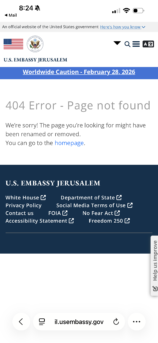
She criticized STEP (Smart Traveler Enrollment Program) alerts as seemingly designed to shift responsibility away from the government, with broken “help” links leading to 404 error pages. Guidance often boils down to sheltering in place or devising personal plans—like taking buses to Egypt, which the U.S. Embassy neither endorses nor opposes. These routes involve self-arranged transport to pickup points, unassisted border crossings handled manually in notebooks, fluctuating visa fines, and handwritten tickets at Egyptian airports lacking computers.
Clark expressed deep concern: “We love America and support a free Iran but we feel like our government is pushing people to the brink of really dangerous decisions out of panic.” Reports of thousands of Jews and Christians crossing into Muslim-majority countries heighten fears of potential targeting, making many reluctant to attempt those paths.
The atmosphere mixes fear, resilience, and unexpected solidarity. Clark shared stories from her bomb shelter community, where people doubt U.S. oversight if they flee to Egypt or Jordan: “If the USA won’t directly help us in Israel there is no way they’ll have tabs on us in Egypt or Jordan.”
Media reports of rescues contrast sharply with reality: “It’s really discouraging to see the news say people are being helped and rescued. But every American in Israel is doing so on their own financial means at their own risk.” Even if airspace reopens, El Al prioritizes existing customers through late March, while many foreign airlines avoid the region entirely.
One poignant case involves an Orthodox Jewish family with five young children in their shelter. Their flights were canceled, El Al won’t rebook, and they’re facing weeks more in Israel without U.S. charter help. Struggling financially in a cramped hotel, they received an offer from Clark’s mother, a Delta flight attendant, who tried to extend companion passes, though Delta prioritizes its own stranded passengers.
Touched by the family’s gratitude—”you’re not normal!! Why are you helping us”—Clark sees gospel-level reconciliation unfolding: “Our Jewish brothers and sisters are being reconciled with Christians in this chaos.” They’ve formed prayer circles for the family and built bonds with other Jewish friends, celebrating a bar mitzvah and Purim in the shelter, reading Psalms together amid missile alerts. “Despite the uncertainty and conflicting / risky directions from the USA, God is using this to bring His children together and for Gentiles to love on His chosen people.”
Clark shared the urgent plea, not just for her family, but for all Americans currently stranded in Israel: “Please continue to pray for SWIFT and SAFE assistance of stranded Americans in Israel. We need charter plans as soon as the airspace opens up! Commercial will be VERY hard to come by and expensive for most.”
In the midst of this widespread crisis, moments of unexpected solidarity and faith —like the prayer circles, shared Purim celebrations, and a bar mitzvah in bomb shelters —along with the cross-cultural bonds Clark witnessed, shine through, reminding us of humanity’s resilience even in turmoil.
Clark’s final words to us were: “GOD BLESS AMERICA GOD BLESS ISRAEL! PLEASE HELP JEWS AND CHRISTIANS GET HOME!!!“
